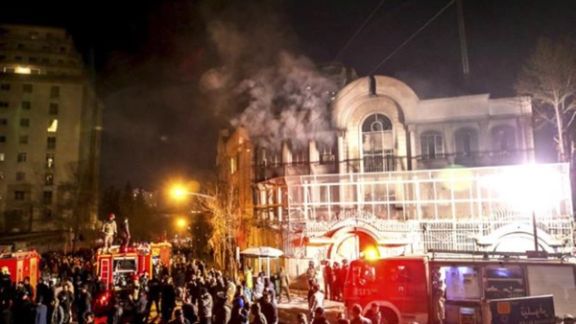
Iranian protesters burning the Saudi Embassy in Tehran. January 2016
Saudi Arabia’s interest in improving relations with Iran is diminishing, according to a member of the Iranian parliament’s National Security and Foreign Policy Committee.
While Tehran and Riyadh – which have no formal diplomatic relations – back different sides in various regional conflicts, including Syria and Yemen, the two sides have held several rounds of exploratory talks in Baghdad.
"There were signals of Saudi's interest in reviving relations, but these signs have currently lost their luster a little,” parliamentarian Mahmoud Abbaszadeh-Meshkini told Shafaqna (Shia News Association) Friday. “Some signals have even turned into their opposite."
While Iran had "repeatedly announced that we seek improvement of relations,” Abbaszadeh-Meshkini said, the “groundwork” required before “official” talks had not been carried out. The parliamentarian also suggested that Iran's foreign policy was now more "focused on Asia and neighboring countries."
President Ebrahim Raisi (Raeesi) took office in August announcing a desire to improve Shia-Sunni relations, within Iran and across the region, as well as developing better ties with neighbors. Raisi’s goal might be to reduce Western pressure for discussing Iran’s regional behavior that has seriously alarmed Sunni states and Israel.
Saudi Arabia severed relations with Iran in January 2016 after a mob attacked its diplomatic missions in Tehran and Mashhad. The embassy in Tehran was set on fire and looted while Iranian security forces stood by.
Raisi’s foreign minister Hossein Amir-Abdollahian, who is speaks Arabic, held responsibility for Arab affairs as deputy foreign minister (2011-16) and was ambassador to Bahrain 2007-2010.
But Saudi Foreign Minister Prince Faisal bin Farhan al-Saud said October 15 that Iran was accelerating its nuclear activities and thereby putting the region in “a very dangerous place.”
Iran’s foreign ministry said October 31 after four rounds of talks with Saudi Arabia that reopening of embassies would "take some time.” Prince Faisal noted that “solid progress had been made” that was “positive enough to allow for further discussion beyond, but nothing concrete as of yet.”
Conservative and hardline media in Iran this week condemned Saudi Arabia for expelling the Lebanese ambassador, banning Lebanon’s imports and demanding the resignation of Lebanon’s information minister George Kordahi after reports emerged of remarks he made before becoming a minister in which he described the Saudi intervention in Yemen as “aggression.”
Lebanon’s prime minister Najib Mikati, a Sunni, again called Thursday for Kordahi, a Christian, to step down to avoid further Saudi escalation as Riyadh rallied support for its move among other Sunni-led Gulf states, including Kuwait and the United Arab Emirates. Some analysts have interpreted the Saudi action as indirectly targeting the Allawi-led government in Syria, which is battling mainly Sunni rebels backed by Saudi Arabia, or even targeting Iran, whose Shia ally Hezbollah is supporting Kordahi.
President Ebrahim Raisi’s top economic official says Iran has been “smuggling oil and bringing the dollars back secretly” because of “illegal” US sanctions.
Mohsen Rezaei, First Vice President for economic affairs, told a gathering during a provincial visit that Iran accepted all condition during nuclear talks with world powers and agreed to the 2015 nuclear deal (JCPOA), but “The next US government violated it and put us under economic siege.”
After former president Donald Trump withdrew from the JCPOA in May 2018 and imposed sanctions, Iran’s oil exports dramatically fell and then increased somewhat a year ago coinciding with the election of Joe Biden as President.
Iran exports most of what it sells now to China, although official Chinese data do not reflect any Iranian oil imports. No one knows how much oil Iran smuggles, but estimates put the number at around $10 for the past 12 months.
Although Rezaei says Iran repatriates the proceeds in cash dollars, the oil is sold at a discount and through middlemen who make a lot profit.
Secretary of State Antony Blinken with the Saudi foreign minister in Washington. October 2021
The Biden Administration approved its first major arms sale to Saudi Arabia for 280 air-to-air missiles valued at $650 million, the Pentagon said on Thursday.
While Saudi Arabia is an important partner in the Middle East, US lawmakers have criticized Riyadh for its involvement in the war in Yemen. They have refused to approve many military sales for the kingdom without assurances US equipment would not be used to kill civilians.
The Pentagon notified Congress of the sale on Thursday. If approved, the deal would be the first sale to Saudi Arabia since the Biden administration adopted a policy of selling only defensive weapons to the Gulf ally.
The State Department had approved the sale on Oct. 26, a spokesperson said, adding that the air-to-air missile sale comes after "an increase in cross-border attacks against Saudi Arabia over the past year."
The sale "is fully consistent with the administration's pledge to lead with diplomacy to end the conflict in Yemen," the State Department spokesperson said in a statement. The air-to-air missiles ensure "Saudi Arabia has the means to defend itself from Iranian-backed Houthi air attacks," he said.
After the Trump administration's friendly relationship with Riyadh, the Biden administration recalculated its approach to Saudi Arabia, because of human rights concerns, but which is also one of Washington's closest allies in countering the threat posed by Iran.
A Cypriot judge on November 1 extended the detention of a 38-year-old Azeri, arrested in Nicosia September 27, allegedly involved in a terror plot against Israeli businessmen.
This was the fifth consecutive eight-day detention order without charges being made. Based on information collected by Iran International it is clear that the Cypriot police is conducting a possible terror investigation.
Police said they found a pistol, an Xtouch Technology Sub Compac 9mm, which had been hidden by a 27-year-old Pakistani, one of six people held in what Israel has alleged is an Iranian plot against Israeli businessmen. The others are Pakistanis aged 27, 22 and 32, and a 21-year-old Lebanese, who was arrested on October 28.
A total of 11 charges are being investigated against the 38-year-old Azeri, who is a permanent resident of Moscow, originally from Azerbaijan, who holds a Russian passport.
The 27-year-old Pakistani was connected to the Azeri main suspect through telephone records. The police have found three pistols, the first, a potentially lethal ‘click-gas weapon,’ in the possession of the Azeri when arrested September 27 in the parking lot of a Nicosia swimming pool.
Fanis Makrides, journalist at Politis newspaper in Cyprus, told Iran International on Wednesday that Greek Cypriot police and security officials involved in the case had confirmed to him that they suspected “terrorism.”
“What we know…[from what is] officially being said by the Prime Minister's office in Israel [is] that the 38-year-old Azeri is connected to a plan by Iran, in which the Azeri wanted to harm Israel in Greek Cypriot territory,” Makrides said.
The spokesman for Israeli prime minister Naftali Bennett on October 4 said the arrests followed a “terrorist incident directed by Iran against Israeli businesspeople living in Cyprus.” The Iranian embassy in Cyprus told Reuters the Israeli “regime is always making such a baseless allegation [sic].”
“When it comes to the third pistol that was found, [this] means that now we have something really organized,” Makrides told Iran International. “These people were moving around in all cities of the Greek part of Cyprus, such as Nicosia, Limassol and Paphos and they were in touch with each other. So, they were preparing something big.”
Makrides described Cyprus as a “mediator” between Israel and Iran, which meant the Greek Cypriot police had to be “very careful with the accusations and how the whole case will be treated.” The journalist claimed he knew that agents of Mossad, external Israeli intelligence, were in Cyprus “helping” with the case.
“When Mossad agents learned about the planned terror attack, they informed the Greek Cypriot police,” Makrides said. “We know that the Greek Cypriot police after this information, started to watch the 38-year-old Azeri…[who] was in Cyprus from early September 2021 …[he] was watching people and travelling to the Turkish part of Cyprus. He was in touch with various people.”
The journalist claimed the police made the arrest when they did because the suspect was “about to complete his goals.”
Makrides said the police continue to investigate whether the suspect planned to kill the Israeli billionaire Teddy Sagi, who acquired Greek Cypriot citizenship, and therefore a European Union passport in 2009. Sagi has been listed by Forbes as the fourth richest Israeli, worth $5.6 billion.
“My sources told me the information that if Iran is behind this, wanting to harm Israel, then Iran could easily harm Israeli businessmen in Cyprus, as the consequences are high, especially if it's a billionaire like Teddy Sagi,” Makrides said. “Let's not forget that the Azeri is still a suspect, and the decision [to prosecute] is not being taken yet. But, yes, the 38-year-old Azeri might have had a target to harm Israeli businessmen in Nicosia.”
An official in charges of setting wages in Iran says that the monthly living basket for a family has risen to more than double the income of an average worker.
The head of the supreme labor committee said on Thursday that a basket of essential supplies for a family of 3 has reached 115 million rials. Although in today’s exchange rate that amounts to just $425, but a typical worker in Iran receives much less than $200 a month.
Faramarx Tofighi told the Iranian Labour News Agency (ILNA) that a worker’s wages would just be enough for buying the minimum amount of food for a family while rent and other expenses would go unpaid.
Iran’s overall inflation rate has reached nearly 50 percent, while food prices have risen much faster. ILNA said that on average food prices have gone up by 66 percent. Half of all families have stopped buying meat and fruits.
With US sanctions since 2018, the national currency has dropped almost ninefold, dropping to 270,000 rials for a US dollar.
Lebanon's prime minister Najib Mikati Thursday repeated his call for information minister Georges Kordahi to step down over a diplomatic rift with Saudi Arabia.
Mikati said the resignation would help resolve a crisis that's destabilized the Lebanese government and made the country's economic plight even worse.
He also had stern words for his partners in government — the militant Hezbollah group and its allies — who have rejected calls that Kordahi resign.
The spat was triggered by Kordahi's remarks aired last week about the war in Yemen, where a Saudi-led coalition is battling Iran-backed Houthi rebels.
Riyadh has withdrawn its ambassador from Beirut and asked the Lebanese envoy to leave the kingdom.
It has also banned Lebanese imports, undermining the small nation's foreign trade and depriving it of millions of dollars while it is deep in an economic crisis.
Lebanon had sought French and US mediation with Saudi Arabia.
Mikati's message appears to be directed mostly at his government partners from the Iran-allied Hezbollah.
Kordahi was named to the government by part of the Hezbollah alliance within the government.
He has refused to resign, insisting Yemen's Houthis have the right to defend themselves and saying he did not mean to offend with his comments, recorded before he became minister.
Gulf Arab countries have joined Saudi Arabia in pulling out their diplomats, deepening the diplomatic spat.