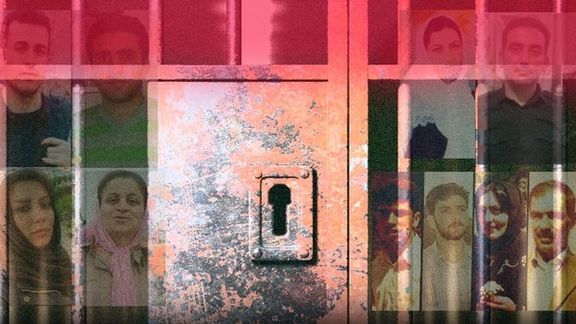
A Kurdish NGO has described widespread torture carried out in Revolutionary Guards and intelligence ministry secret detention centers in Kurdish areas of Iran.
In its report last week based on interviews with former detainees, France-based Kurdistan Human Rights Network (KHRN), a non-governmental organization (NGO) focused on Iran's Kurdish areas, alleged that torture like attaching weights to testicles, hanging detainees from the ceiling, and beating them with hoses and cables was “prevalent.”
The KHRN cited an intelligence ministry detention center in Orumiyeh, West Azarbaijan province, and two IRGC centers in Orumiyeh and Sanandaj, both in Kurdistan province. It said one detention center had very small cells known as graves.
The ex-detainees told KHRN that interrogators had used threats − including raping the detainees' families − to extract confessions. One detainee, who said he had been held at the IRGC detention center in Sanandaj, told KHRN that he was not taken to hospital for 29 days despite having been shot in the leg. Detainees also said interrogators also staged fake executions to encourage confessions.
Former Kurdish political prisoner Mohammad-Hossein Rezaei, who spent time at the intelligence ministry's Sanandaj detention center, told KHRN that he had been tied to a table and beaten with cables, damaging his nose and ribs.
Roya Toloui, a Kurdish journalist and civil rights activist now living in the US has claimed that after her arrest in 2006 she was tortured and raped in at intelligence ministry detention center of Sanandaj for refusing to put her signature on confessions that had been written by her interrogators.
The report said the IRGC intelligence in West Azerbaijan province had the capacity to detain several hundred.
Several illegal Kurdish parties seeking either Kurdish autonomy within a federal Iran or an independent state are active in Iran’s Kurdish regions. Iranian military commanders have issued repeated warning in recent months they will strike the bases of these groups in Kurdish-held northern Iraq.
While conditions in jails in Kurdish regions are generally harsher than elsewhere, there has been some international interest in Iranian prison conditions since the release in August by hackers of footage from security cameras that had been installed in Evin prison, Tehran, at the instruction of parliament. Mohammad-Mehdi Haj-Mohammadi, the head of Iran's Prisons Organization, apologized and said action would be taken against staff mistreating prisoners.
In a series of tweets in September, activist-cum-citizens’ journalist Sepideh Gholian (Qolian), out on parole from Bushehr prison, southern Iran, alleged abuse of female prisoners in the prison. She wrote that she had reported 20 cases to the authorities, including five described in her tweets, but had received no response.
A man walks near a newspaper with a headline that reads " Saudi Arabia announces a boycott with Lebanon" in Beirut, October 30, 2021.
Conservative and pro-IRGC media in Iran have condemned Saudi Arabia’s tough response to critical remarks by a Lebanese government minister.
Amid talks with Riyadh, Tehran media controlled by the state or by the Revolutionary Guard see Saudi Arabia’s decision to expel the Lebanese ambassador as an assault at Hezbollah’s sway in Lebaese politics.
Alef, a conservative website said Monday that Saudi Arabia’s ambassador in Beirut refrained from even congratulating the formation of the new government after Saad Hariri, Riyadh’s preferred candidate for prime minister failed in his bid to form a cabinet. The paper reasoned that Saudis are angry at Hezbollah for having succeeded in putting together a government.
Saudi Arabia expelled Lebanon's envoy and banned all Lebanese imports on Friday, and Bahrain and Kuwait followed suit, giving the top Lebanese diplomats 48 hours to exit. The United Arab Emirates later said it would withdraw all its diplomats and banned its citizens from traveling to Lebanon.
The crisis began when a in a program taped in August, a current minister in the Lebanese government, George Kordahi, criticized Saudi Arabia’s involvement in Yemen’s war, calling it an aggression. Kordahi refused to resign his cabinet post, saying he did not mean any disrespect to Saudi Arabia.
The Saudi Foreign Minister Prince Faisal bin Farhan Al Saud in an interview with Reuters on Saturday acknowledged that the issue with Lebanon is the power and influence Hezbollah exercises.
"I think the issue is far broader than the current situation," bin said. "I think it's important that the government in Lebanon or the Lebanese establishment forges a path forward that frees Lebanon from the current political construct, which reinforces the dominance of Hezbollah."
The IRGC-affiliated Fars news agency in Tehran wrote harshly about the Saudi response on Monday. “This kind of incidents rarely happen in the diplomatic world, and we can say it is consistent with the interventionist and dominance-seeking nature of the Saudis.”
Fars quoted foreign minister bin Farahan’s interview and says that Riyadh candidly has explained why “it has gone to war against Lebanon”. The reason, Fars said, is Hezbollah and Saudi Arabia’s belief that Lebanon will not accommodate Saudi policies as long as the Shiite organization sways any influence. Fars went on to say that Riyadh has experienced repeated defeats in the region. They see Yemen “as lost”, while they also lost in their bid to pressure Qatar.
Fars went as far as saying that Qatar withstood a Saudi boycott thanks to help it received from Iran and Turkey. It added that Hezbollah will never be “eliminated” from the Lebanese political life.
The incident with the Lebanese minister, Saudi Arabia’s sensitivity in the matter and Iran’s claims of victory show how far the two regional rivals are from reaching a mutual understanding in their talks.
Iran wants to continue the talks to prevent Western demands of discussing its regional policies alongside nuclear talks. Saudi Arabia continues the talks to show good faith to the Biden Administration that probably is keen to entangle the complicated web of issues related to Iran and make a nuclear deal simpler to achieve.
Mahmoud Nabavian member of Iran's parliament. FILE PHOTO
Iran has expanded it borders to Syria, Lebanon and Yemen, a senior lawmaker in Iran’s parliament has said, rejecting any talks with the West over the issue.
Mahmoud Nabavian, a cleric and a hardliner politician representing a constituency near Tehran told a local website that while the United States has forces in the Persian Gulf, “We should not remain within our borders”.
He added that the reason “enemies cannot make Iran insecure is that we have expanded our borders and now Iran’s borders are in Syria, Lebanon, Yemen and Iraq.” He rejected Western demands that Iran should negotiate over its role in the Middle East, arguing that “They want to take the region from us.”
Nabavian also dismissed another Western demand that Iran should discuss its ballistic missile issue. “They want to take our missile power from us so we will have nothing if enemies attack us.” The ultraconservative lawmaker went on to say that Iran should never agree to negotiate with the West over its regional policies and missile power.
Predictably, Nabavian also dismissed negotiations over Iran’s nuclear program, saying that the 2015 nuclear deal (JCPOA) brought no benefits for Tehran. He said the issue is not just sanctions imposed by former US president Donald Trump, but the same anti-Iran agenda was pursued by the Obama administration.
South Korean ambassador in Iran donating masks to a hospital. October 31, 2021
Iranians are criticizing the South Korean embassy in Tehran for donating 2,000 Covid masks to a hospital while Seoul keeps $7 billion of Iran’s frozen funds.
Ambassador Yun Kang-hyeon visited a private hospital in Tehran on Sunday and donated Covid masks, in what conservative media in Iran and several prominent citizens criticized as an insensitive act.
Some media outlets called the ambassador’s donation a “humiliating act” as Seoul has refused to release $7 billion of Iran’s money frozen by two of its banks, since the US imposed banking sanctions on Iran in 2018.
The embassy tweeted pictures of the ambassador’s visit to the hospital showing a few cartons of masks. This led to negative reactions, with Alef conservative website not only criticizing the embassy but also attacking the private hospital for accepting the gift.
“Is anyone in this hospital reading newspapers or following the news to know what South Korea has done to us during sanctions?”, the newspaper asked.
Iran foreign ministry spokesman Saeed Khatibzadeh also reacted to the news on Monday calling the donation “a joke”.
Long lines at Iran's gas stations as a result of a mysterious disruption. October 26, 2021
Almost a week after a major disruption at more than 4,000 gas stations in Iran, officials say it is not clear whether it was a cyberattack or sabotage in Iran.
Since October 26, Iran has been trying to fix a payment system at all gas station nationwide that suddenly broke down, creating a major disruption. The system provides a limited amount of cheap, subsidized fuel to every citizen and the without it, people have only one option, paying double for freely sold fuel.
Officials and local media initially said it was a cyberattack, but that raised questions, since reportedly the payment system is not connected to the Internet.
By Monday, 20 percent of all locations still could not sell the cheaper gas, as gas stations were gradually coming back to full operations.
The spokesman of parliament’s security committee, Mahmoud Abbas Meshkinzadeh, announced Monday that government agencies have not reached a concensus over the cause of the disruption and are not certain if it was a cyberattack from abroad or infiltration and sabotage from within Iran.
Iran International never reported the incident as a proven cyberattack, since there was never independent confirmation and relying only on statements by Iranian officials in a security-related matter would be a mistake.
Meshkinzadeh’s statement about lack of a conclusion came as a top Revolutionary Guard commander, Gholamreza Jalai, in charge of Iran’s civil defense organization said Saturday that analysis showed Israel and the United States were behind the disruption, although no forensic evidence has been found.
“We are still unable to say forensically, but analytically I believe it was carried out by the Zionist regime, the Americans and their agents,” Jalali said.
Meshkinzadeh said that the oil ministry, the intelligence ministry, civil defense officials and others held a meeting at parliament’s security committee to discuss ways to deter cyberattacks, but the overall conclusion was that the cause of the incident with gasoline distribution remained unclear.
He added that infiltration and sabotage is not a far-fetched scenario, and the parliamentary committee will do a more in-depth study and will issue a final report.
Iran has been the subject of mysterious attacks since July 2020 that twice caused explosions in its high-security Natanz uranium enrichment facility, causing major damage. Most observers and major international media outlets, as well as Iranian officials, have pointed fingers at Israel, which routinely neither confirms nor denies such reports.
Another spectacular operation that happened in public and showed the level of alleged Israeli infiltration, was the Hollywood thriller-style assassination of Iran’s top nuclear scientist and official, Mohsen Fakhrizadeh, in November 2020. All accounts eventually said that a sophisticated, remote-controlled machinegun installed in a van parked alongside the road opened fire on Fakhrizadeh’s approaching vehicle, killing him on the spot.
President Joe Biden has said on Sunday that the United States will "respond" to actions Iran has taken against Washington's interests, including drone strikes.
“With regards to the issue of how we’re going to respond to their actions against interest of the US, whether they are drone strikes or anything else, is we’re going to respond,” Biden said in a press conference following the G20 summit in Rome.
A Us base in Syria came under attack recently with drones suspected to have been launched by Iran-backed militias.
Officials said on October 25 that the US believes that Iran resourced and encouraged the attack, but that the drones were not launched from Iran. They were Iranian drones, and Iran appears to have facilitated their use, officials said, speaking on condition of anonymity to discuss details that have not been made public.
Iranian backed militias have also attacked bases hosting US troops in Iraq, recently using drones more often than rockets.
The US Treasury Department on Friday sanctioned two senior members of Iran’s Revolutionary Guard (IRGC) and two affiliated companies for supplying lethal drones to insurgent groups in Iraq, Lebanon, Yemen, and Ethiopia.
Biden's threat comes as the US and its European allies urge Iran to return to nuclear talks aimed at restoring the 2015 Iran deal.