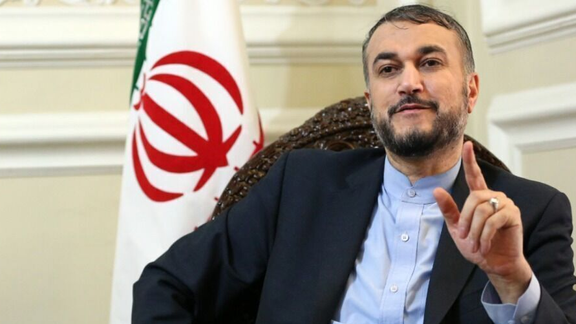
Iran's foreign minister insists that to revive the 2015 nuclear deal, the US must first show "good will" and turn the clock back to 2018 when it left the deal.
In an exclusive interview published Sunday by the government mouthpiece, Iran newspaper, the top Iranian diplomat said Tehran expects the US to return to the time before Trump sanctions began, if the President Joe Biden seriously wishes to revive the agreement that his predecessor abandoned. Iran will also return to the same point in the Joint Comprehensive Plan of Action (JCPOA), he said.
Amir-Abdollahian insisted that there is no need for so much negotiation and a "simpler solution" to revive the JCPOA would be if Biden issues an executive order and return to where things were in May 2018.
"We hear [about the US] will and intention [to do so] in their messages but we don't see it in their actions," he said while reiterating that the US should release $10 billion of Iran's frozen funds to prove its "good will", because Iran is very distrustful of their intentions.
A return to 2018 for Iran would mean the lifting of "all Trump sanctions" many of which are not directly or even indirectly related to Iran's nuclear activities. Iran will in return set its nuclear program to the same pace and form as it was in 2018, Iranian officials say. But this fails to take into consideration the different current circumstances including the complexity of the sanctions and the reversal of gains Iran has made in its nuclear program since 2018.
The JCPOA put a 3.65-percent enrichment cap on Iran but since the US withdrawal from the pact, Iran has installed advanced, more powerful centrifuges such allowing it to reach faster and much higher levels of enrichment and has stockpiled 20-percent and 60-percent enriched fissile material that has no civilian use. Iran may retire its advanced centrifuges and give up its stockpile of highly enriched uranium, but it gets to keep the know-how and experience gained in the process.
Arguing that Iran has gained nothing from the JCPOA, including the lifting of UN sanctions in the years following its conclusion, the top Iranian diplomat alleged that former US president Barack Obama was the first one to violate the nuclear deal and that more violations followed by Trump who withdrew from the agreement. He did not specify what had Obama violated.
Iran could say that six UN resolutions against the country had been lifted with a settlement that six other parties to the JCPOA also agreed on and that the issue of sanctions was solved, "if it had benefitted from the agreement", he said, adding: "There is now a thick document in several hundred pages called the JCPOA which has made things even harder for Iran than the six UN resolutions [that it lifted]," he said.
Iran has also insisted that the US gives assurances not to leave the deal if Tehran abides by its commitments. According to a joint statement issued Saturday by Germany, France and the UK Sunday after a meeting on the margins of the G20 in Rome attended by Biden, Angela Merkel, Emmanuel Macron and Boris Johnson, the US president has agreed to return to JCPOA and stay in the deal. “We welcome President Biden’s clearly demonstrated commitment to return the US to full compliance with the JCPOA [joint comprehensive plan of action] and to stay in full compliance, so long as Iran does the same,” the statement said.
But this is a verbal agreement not a ratified treaty and Iran might not satisfied that a future US government would not once again withdraw from the agreement. Once issue with JCPOA, experts have said, is the fact that Obama avoided presenting it for ratification, which made it easier for Trump to abandon the deal.
In his interview with Iran newspaper, Amir-Abdollahian also rejected “excessive demands” by the US and some European countries to include regional issues in negotiations with Iran. "We have no plans to hold talks with them on regional issues,” he said, insisting that talks will be limited to the nuclear issue and the JCPOA.
The leaders of US, UK, France and Germany in the ROME G20 meeting. October 30, 2021
The United States and three European powers have backed reviving Iran’s 2015 nuclear deal while expressing “growing concern” over its expanding program and reduced access for UN inspectors.
President Joe Biden, French President Emmanuel Macron, German Chancellor Angela Merkel, and British Prime Minister Boris Johnson charged that Tehran had “halted negotiations” in Vienna on a return to the nuclear deal – the JCPOA, Joint Comprehensive Plan of Action. The talks been suspended since June, first for Iran’s new administration to assess options and then Tehran’s unwillingness to resume negotiations.
The statement said Iran’s nuclear steps had been “made more alarming” because it had “simultaneously decreased cooperation and transparency with the International Atomic Energy Agency (IAEA).” Both the “nuclear advances” and “obstacles” to the IAEA’s work threatened to “jeopardize the possibility of a return to the JCPOA.”
Since Biden took office in January with a commitment to return to the JCPOA, which previous president Donald Trump left in 2018, he has looked to improve relations with the three European JCPOA signatories – France, Germany, and the United Kingdom.
The so-called ‘E3,’ like the other signatories China and Russia, have stressed the need both for the US to return to the agreement by lifting the ‘maximum pressure’ sanctions imposed by Trump and for Iran to reverse a series of steps taken since 2019 in expanding its nuclear program beyond JCPOA limits.
Both Biden’s outreach to Europe and the accelerated pace of Iran’s nuclear program have brought the US and Europe closer.
The US-E3 statement also expressed commitment to “continuing to work closely” with Russia and China, who have stressed the US responsibility, as the party that left the JCPOA, to ensure the success of the Vienna talks.
While diplomats in Vienna said the talks made significant progress, the greatest challenges lay in agreeing which US sanctions were incompatible with the JCPOA and exactly how Iran’s developed program should be incorporated within JCPOA limits, including its use of more advanced centrifuges.
Reduced risk of a nuclear crisis
Saturday’s statement highlighted Iran’s production of highly enriched uranium and enriched uranium metal. “Iran has no credible civilian need for either measure,” the statement said.
Tehran began enriching to 20 percent in January, and reduced IAEA access, following last November’s assassination of scientist Mohsen Fakhrizadeh, and began enriching to 60 percent in April after sabotage at its Natanz enrichment site. Iran is barred under the JCPOA from enriching above 3.67 percent and until from producing uranium metal, used in fuel plates for the Tehran Research Reactor.
The US-E3 statement also referred to “our Gulf partners’ regional diplomatic efforts to deescalate tensions,” an apparent reference to Iraq-brokered meetings between Iran and Saudi Arabia reportedly discussing the restoration of diplomatic relations and ending the war in Yemen. The statement suggested that a “return to the JCPOA” and the resulting easing of sanctions would allow “for enhanced regional partnerships and a reduced risk of a nuclear crisis that would derail regional diplomacy.”
At the same time, acknowledging Saudi concerns over Iran’s regional influence, the statement affirmed “our shared determination to address broader security concerns raised by Iran’s actions in the region.” Both Saudi Arabia and Israel opposed the JCPOA and have been adjusting both to the Biden administration’s commitment to revive the deal and its desire to reduce the US military presence in the region.
US President Joe Biden has met with the British, French and German leaders in Rome to discuss strategy and coordination regarding Iran's nuclear program.
UK Prime Minister Boris Johnson, French President Emmanuel Macron, German Chancellor Angela Merkel and Joe Biden met on the sidelines of the G-20 summit in Rome to discuss the next steps on Iran's nuclear program.
The four posed for a group photo before they went behind closed doors for their consultations.
Biden's meeting with the leaders of Germany, France, and Britain - known as the E3 - comes at a pivotal time, as Iran continues to enrich uranium to near-weapons-grade levels.
Biden is trying to revive the 2015 nuclear deal and bring Iran back into compliance with the pact that would have kept the Islamic republic at least one year away from the potential to field a nuclear weapon.
US national security adviser Jake Sullivan said the meeting would feature the leaders “all singing from the same song sheet on this issue.”
Amidst tense relations between France and Britain over post-Brexit fishing rights, Johnson and Macron walked away from the photo with arms around each other.
US President Joe Biden poses for a picture as he arrives for the G20 leaders' summit in Rome, Italy October 30, 2021.
The US and its allies may now be more willing to impose penalties if Iran continues acting in violation of its nuclear deal and delaying talks to revive it.
Sources in Washington told the CNN Friday that US officials are very skeptical of any breakthrough in renewed nuclear talks with Iran over the agreement, the Joint Comprehensive Plan of Action (JCPOA), and are "actively" discussing imposing new penalties on Tehran.
"They say the US and its allies are now more willing to impose a higher cost on Iran for failing to come to an agreement if Tehran continues to take actions that are inconsistent with the 2015 nuclear deal and bring it closer to developing a nuclear weapon," CNN reported.
The sources cited would not provide details of these costs might be, the network reported. Washington under its ‘maximum pressure’ sanctions already threatens punitive action against any third countries or parties dealing with Iran, and has sanctioned most senior Iranian officials including President Ebrahim Raisi (Raeesi) and Supreme Leader Ali Khamenei.
The US and the European powers express concern about Iran’s uranium enrichment to a high level of purity − some of which they claim has no civilian use − and other knowledge and experience Tehran has gained in building up its nuclear program since the US left the JCPOA in 2018.
On June 20, two days after the election of Raisi to the presidency, Iran suspended the talks that began in Vienna in April. Since then the new administration has been reviewing the process and only recently said it expected talks – at least with remaining JCPOA members – to resume by the end of November.
President Joe Biden, who is in Rome for the G20 summit this weekend, will discuss possible coordination over Iran with leaders of the three European powers – France, Germany and Britain – who are JCPOA signatories, along with China and Russia. The ‘E3’ have called on both the US and Iran to respect the JCPOA.
Iran’s Foreign Minister Hossein Amir-Abdollahian reiterated Wednesday that Biden should show goodwill by ‘allowing’ the release of $10 billion of Iran’s funds frozen by Asian banks wary of US punitive action.
Deputy Foreign Minister Ali Bagheri-Kani has also stressed that talks can succeed only with the full removal of sanctions as required by the JCPOA. It has been widely reported that in recent discussions with the European Union, Tehran has sought guarantees from other JCPOA signatories that the US could not again leave the JCPOA once it returned.
Iran's Foreign Ministry Spokesman Saeed Khatibzadeh said that fresh sanctions on Iranian entities and persons imposed by the US Treasury Friday contradicted Washington’s claim of willingness to revive the JCPOA and showed the Biden administration was continuing the approach of former President Donald Trump.
The US Treasury sanctioned companies and individuals connected with Iran’s military drone development. A recent drone attack on US troops in southern Syria who train forces fighting to overthrow President Bashar al-Assad was, officials said, “resourced and encouraged” by Iran.
“Together with other JCPOA members and the United States, which we have been talking about for more than four months, we are ready to resume negotiations as soon as Iran agrees to set a date,” said a French foreign ministry spokesman Friday.
A US official familiar with the talks told CNN that Iran's public pronouncements "don't give us a huge amount of optimism" and that there was little indication that Iran was intent on resolving the outstanding issues. There was no reason to be optimistic, he said.
Iran could be trying a number of strategies. First, it might be trying to buy time, believing that with is rapid enrichment of uranium it can gain more leverage in the talks. Or, it can be trying to extract more concessions on the removal of US sanctions.
Ali Bagheri Kani meeting with Russia's Sergei Ryabkov. October 29, 2021
New talks between Iran and world powers will only be successful if they remove US sanctions, Iran’s chief negotiator and Russian foreign ministry have said.
Ali Bagheri Kani, who is also deputy foreign minister, met with his Russian counterpart Sergei Ryabkov in Moscow on Friday, where they discussed the Iran nuclear talks with the United States and the remaining members of the 2015 nuclear agreement, the JCPOA.
Iran’s official government news website IRNA quoted the two diplomats as saying after their meeting that “The new talks will only be successful if they lead to the removal of sanctions and the full implementation by the parties of their commitments.”
Bagheri Kani was quoted earlier as saying that Iran is negotiating with 4+1, which are three European members of the JCPOA, Russia and China, while the nuclear talks earlier this year in Vienna also included the United States on the sidelines negotiating indirectly.
Bagheri had also emphasized that Iran will carry on discussions on bilateral basis with 4+1. There are also reports that Iran is willing to meet with the remaining members of JCPOA collectively, but intentionally or not, Iranian statements seem to be often different from one another.
At the same time, Iran’s Foreign Minister Hossein Amir-Abdollahian demanded on Wednesday that the US must show “goodwill” and release $10 billion of Iran’s frozen funds to help advance the talks, while Bagheri who met with the EU negotiator Enrique Mora in Brussels on Wednesday said the Vienna talks will resume by the end of November.
Asked in Moscow on Thursday if there is a more concrete date, Bagheri said, “What is more important in the new round of negotiations is the readiness of the other side to make serious decisions about lifting sanctions.”
On Friday Bagheri was quoted as saying that the United Kingdom, France and Germany “also need to live up to their commitments [under JCPOA] and work to remove the illegal sanctions.”
It is not clear if Tehran is demanding the lifting of US sanctions before a new agreement on reviving the JCPOA is reached, but it seems it is demanding something beyond what has already been agreed in Vienna.
Iran could be trying a number of strategies. First, it might be trying to buy time, believing that with is rapid enrichment of uranium it can gain more leverage in the talks. Or, it can be trying to extract more concessions on the removal of US sanctions. Any new concession by the United States now can relieve pressure on Iran which has to make its own concessions.
Iranian state network Press TV reporting on the Moscow meeting said, “The scope of the sanctions removal and the need for the US to guarantee that it would not ditch the JCPOA again are among the key issues not settled during the administration of former Iranian President Hassan Rouhani.”
If Tehran can get support from the other world powers on the issue of sanctions, it can hope to isolate the United States.
Bagheri also emphasized in Moscow that Russia and China "share common views on regional and international issues [with Iran], including the nuclear agreement, officially called the Joint Comprehensive Plan of Action (JCPOA)."
President Joe Biden will discuss Iran with the leaders of the UK, Germany and France on the sidelines of the G20 meeting this weekend, National Security Advisor Jake Sullivan said on Thursday. He emphasized that Biden’s aim is to coordinate the Western position in the nuclear talks.
This cannot come too soon for the United States as Iran delays multilateral negotiations and tries to build up leverage.
Iran and world powers are trying to agree on a date for the resumption of nuclear talks in Vienna as soon as possible, an EU spokesperson said on Friday.
Iran's top negotiator said after talks in Brussels this week that negotiations in Vienna will resume by the end of November.
EU spokesperson Peter Stano said the October 27 meeting in Brussels was "useful" and "helped to define a way forward to resume negotiations in Vienna".
"We are working together with other partners, including Iran and other signatories (of the Iran nuclear deal - JCPOA), to fix a concrete date as early as possible to reconvene in Vienna," Stano told a regular briefing.
In April, Tehran and six powers started to discuss ways to salvage the 2015 nuclear pact, which three years ago then-US President Donald Trump abandoned. Trump then reimposed sanctions on Iran that have devastated its economy by squeezing its oil exports.
But the talks have been on hold since the election of Iran's hardline President Ebrahim Raisi in June, who is expected to take a tough approach if the talks resume in Vienna.