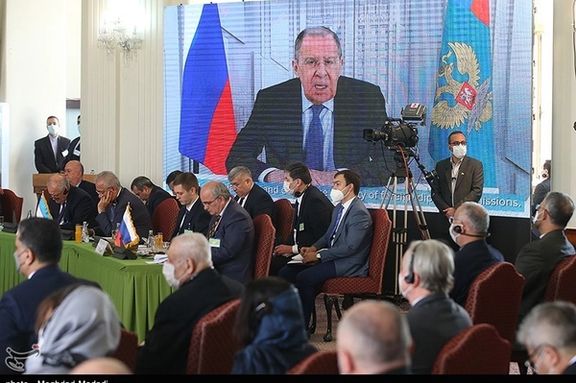
Russia foreign minister Sergey Lavrov addressing the Afghanistan conference in Iran. October 27, 2021
A meeting of Afghanistan’s neighboring states in Tehran condemned violent attacks "in all shapes and forms including those against ethnic and religious groups."
The foreign ministers of Iran, Pakistan, Turkmenistan, Uzbekistan, Tajikistan, China, and Russia called Wednesday for an "inclusive and broad-based political structure with the participation of all ethno-political groups," and urged the world, including the United Nations, to provide urgent economic and humanitarian assistance.
The message of the conference in Tehran was clear, Iranian foreign minister Hossein Amir-Abdollahian tweeted Wednesday afternoon: "Peace will only stem from [an] inclusive government [and] respect for [the] will of Afghan people."
In a press conference after the meeting, Amir-Abdollahian said the Taliban were in charge of a caretaker government. Amir-Abdollahian said Afghan assets held by foreign banks should be released before winter sets in, and that humanitarian and economic support should be provided to prevent insurgents exploiting hardships.
Iran’s neighbors have delayed formal recognition of the new authorities but there is growing acceptance internationally of the new reality in Kabul. The European Union is soon to reopen its diplomatic mission, withdrawn to Qatar in August.
Iran has said that one aim of holding the Tehran meeting was to convey the message of "opposition to foreign interference," a sideswipe at the United States, which ended in August its 20-year military presence. The Russian and Chinese foreign ministers participated via video-link, while United Nations Secretary General Antonio Guterres sent a message.
The Taliban were apparently not invited but welcomed the initiative. Opinions in Iran over how to deal with the situation in Afghanistan are mixed, with reformist and some conservative voices opposing recognizing the Taliban without offering a clear alternative.
Russia has suggested it would recognize the Taliban if it met several conditions. Amir- Abdollahian said participants had reached basic agreement on the Taliban joining the next neighbors’ gathering provided representatives of all major Afghan ethnic groups were present.
The meeting came a week after the meeting in the Russian capital of ‘Moscow Format Consultations on Afghanistan,’ which brought together Russia, China, Iran, India, Pakistan, and four central Asia republics. A closing statement – from which Tehran dissented for reasons that remain unclear – assessed the Taliban as de facto rulers of Afghanistan irrespective of formal recognition internationally.
Turkish President Recep Tayyip Erdogan has said that if Iran acts with a “sound mind”, it will have no difficulty with the neighboring Republic of Azerbaijan.
Media in Baku quoted Erdogan after his visit to Azerbaijan this week as saying that President Ilham Aliyev has an “unshakable position and will not compromise”.
Relations between Tehran and Baku became tense in September when Azerbaijan arrested two Iranian truck drivers on their way to Armenia and then conducted military exercises with Turkey and Pakistan. Iran retaliated by holding its own large-scale drills near the border. Media in the two countries adopted an adversarial tone, but foreign ministers held talks to reduce tensions.
Erdogan, who is a close ally of Aliyev, said Iran’s protests that Baku has close ties with Israel will not change Azerbaijan’s decision making.
Top Iranian officials, including Supreme Leader Ali Khamenei have criticized Baku’s close ties with Israel.
Last week, Erdogan had said Iran would not continue tensions with Azerbaijan as it is concerned about its own Azari-speaking population. Iran’s national security chief responded by dismissing Erdogan’s comments and referring to Turkey’s tensions with its own minorities.
A young Iranian kickboxer who had traveled to Italy for a tournament has left his hotel and reportedly gone to Germany to apply for political asylum.
Omid Ahmadisafa has received permission from Iran’s boxing federation to travel to Italy, where he left his hotel and never returned, according to Khabar Online website in Tehran. Informed sources believe he might have gone to Germany to apply for asylum.
Several Iranian athletes in the past two years have defected from Iranian national teams and sought asylum in other countries. Some took part in the year’s Olympics in Tokyo as non-state athletes.
One of the main issues forcing Iranian sports people to defect is Tehran’s policy of not allowing them to compete against Israelis. Apparently Ahmadisafa was also forced to lose weight to compete in a lower weight class to avoid an Israeli opponent.
Refusing to compete against an opponent for political reasons is banned in international sports, but various federations have so far given Iran a free pass. Iran also does not allow women as spectators in men’s games such as soccer, basketball and volleyball.
Iranian media say Ahmadisafa is a promising young star in light-weight boxing and kickboxing. He has a gold medal from Asian games and a champion in kickboxing.
President Ebrahim Raisi visiting a gas station amid major disruption. October 27, 2021
A day after an apparent cyber-attack on fuel stations across Iran reformist media warned the government to be transparent over any plans to raise fuel prices.
Authorities soon acknowledged the problem and said people, who had formed long queues to refuel their vehicles, could still buy gasolinebut at the unsubsidized rate of 30,000 rials. This only served to deepen suspicions of a secret plan to increase fuel prices.
The reformist Etemad newspaper said the authorities' insistence there were no immediate plans to increase prices could not convince the public.
"The atmosphere of distrust in the announcements and tweets is so strong that at the time of writing this report, Tuesday evening, there are still queues at service stations and more people are rushing there," Etemad opined. "The reason for such distrust is previous [government] behavior regarding increasing fuel prices."
Smart cards are used for buying gasoline, subsidized by the government, at 15,000 rials a liter, around 12 percent of the price in Iraq, 8 percent of the price in Afghanistan, and 7 percent in Turkey.
"Increase in fuel prices in Iran is inevitable but it should be done without the usual denials and retraction…[instead] honestly, transparently and gradually,” Etemad advised. “There will be costs such as what happened in 2019 if previous approaches continue," the paper noted, referring to nation-wide protests under the previous administration when prices were previously increased.
"Occurrence of this incident while already there were rumors about scraping hidden subsidies and the possibility of fuel price increase reinforced the view that the government is planning to scrap subsidized gasoline," the reformist Arman-e Melli newspaper wrote Wednesday.
Following speculation on social media about stringent increase in fuel prices, government officials, including interior minister Ahmad Vahidi, have vehemently denied such plans. Asked by reporters Monday, head of the Planning and Budget Organization Masoud Mir-Kazemi denied there was provision for a hike in fuel prices in next year's budget bill.
Speaking at the cabinet meeting Wednesday morning, President Ebrahim Raisi (Raeesi) said the aim of Tuesday’s disruption at gasoline stations was “to anger people by causing disorder and disruption in their lives." Raisi calling on the oil ministry to avoid any loss in the supply of subsidized fuel.
Authorities initially said the disruption would end by Wednesday but now expect the resumption of all operations at service stations by Thursday. Supplies in around 3,000 service stations stopped as messages of "cyber-attack" appeared on fuel pump monitors that read the smart cards used for purchasing rationed, subsidised gasoline.
Caspian Sea coast shows signs of retreating water. Undated
The head of Iran’s meteorological center has said that the level of the Caspian inland sea has dropped by 1.5 meters (5 feet) in the past 26 years.
Behzad Layeghi told local media that the sea level is dropping by an average of 6 cm per year, which is a significant change according to him. Iran has set up monitoring stations along its shorelines.
The Caspian is a salt water inland sea and the largest lake in the world.
Layeghi said that part of the reason is direct human activities such as river water use for other purposes, but the main cause for sea’s retreat of the Caspian is less precipitation. He added that Russian’s Volga River provides 85 percent of the water flow to the Caspian Sea.
The Iranian official said there could be many reasons for less precipitation in the Caspian basin but the most notable is climate change. He added that the huge loss of water can only be explained by climate change and direct human activities could not cause such a drastic change.
At the opening of a conference on Afghanistan in Tehran, Iran’s foreign minister said that the Taliban are responsible for ensuring security for all citizens.
Hossein Amir-Abdollahian in his opening speech at a meeting of Afghanistan’s neighboring countries and Russia said, “We must emphasize that the responsibility of security for Afghan citizens, as well as security at the borders of this country with its neighbors, first of all lies with the ruling council temporarily in charge of Afghanistan.”
Amir-Abdollahian’s use of the word ‘temporary’ refers to Iran’s position that the Taliban must form an inclusive government in the multi-ethnic, multi-sectarian country.
Iran has also called on the Taliban to provide security after attacks in recent weeks against Afghanistan’s Shiite community, at the same time claiming that the United States is fomenting violence through extremist groups.
The Iranian foreign minister also called on the international community “to pay special attention” to political and humanitarian problems, as well as to terrorism, narcotics trafficking and women’s rights in Afghanistan.
The Iranian foreign ministry had called on the Taliban on Tuesday, ahead of the Tehran conference, to form an inclusive government and prevent violence.
Iran had cautiously welcomed the Taliban takeover in August, saying it was a strategic defeat for the United States.