Senior Fellow, National Union for Democracy in Iran
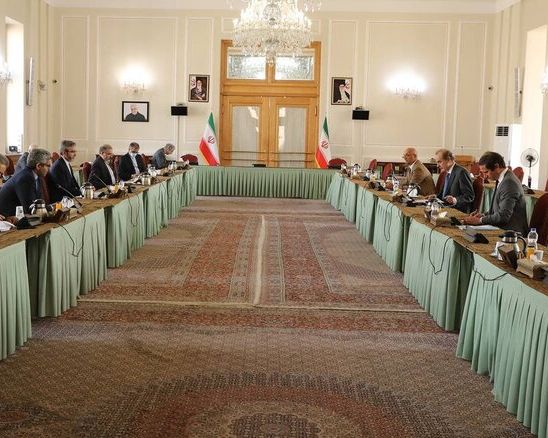
EU's Enrique Mora negotiating with the Iranian delegation in Tehran. Oct. 14,2021
Enrique Mora, the EU envoy coordinating the Iran nuclear talks traveled to Tehran recently in an attempt to convince the regime to return to the Vienna process.
The EU invested considerable political and diplomatic capital in the long process that led to the 2015 accord, formally known as the Joint Comprehensive Plan of Action (JCPOA). EU leaders had tried hard to convince former President Donald Trump not to abrogate the deal, and they have again invested considerable effort, since Joe Biden’s election, to serve as a middleman between Tehran and Washington. All of this diplomacy invites an economic question: What can the EU expect to gain if trade and investment become possible in Iran with the lifting of US sanctions?
The history of Iran-EU trade over the last 15 years shows a downward trend, with a high degree of correlation with the severity of sanctions. When US-initiated secondary sanctions are in place, whether multilateral or unilateral, they quickly affect Iran-EU trade. EU states opposed the Trump administration’s unilateral maximum pressure strategy, but Trump’s sanctions had the same impact on Iran-EU trade as multilateral sanctions did prior to the JCPOA.
In no small part, Iran-EU trade is so sensitive to sancitons because the EU can quickly replace Iran with other trade partners, while Iran can not do likewise. In 2013, at the height of the Obama administration’s sanctions campaign against Iran, EU imports from Iran dropped to 751 million euros from their zenith of 17 billion euros in 2011.
In 2019, the first full year that Trump’s maximum pressure strategy was in place, EU imports from Iran slid to 680 million euros, down from 9 billion euros in 2018. EU exports, while reduced due to US sanctions, have shown less volatility. The EU’s 2013 exports plummeted to 5.3 billion euros from their high of 11 billion euros in 2010. These exports went back up to 11 billion euros in 2017 while the JCPOA was in effect, but in 2020 descended to 3.7 billion euros. Non-Iranian trade partners filled the gaps.
By contrast, trade between the EU and Saudi Arabia, Tehran’s chief rival in the Persian Gulf, benefits from diplomatic stability. Since 2005, EU-Saudi trade has enjoyed a general upward trajectory, even though it is sensitive to volatile markets for oil. However, the Saudis have managed to expand their non-crude exports to the EU. In 2020, 7.2 billion euros — 46 percent of Riyadh’s exports to the EU — were from non-crude oil, up from 3.84 billion euro in 2005.
The greater volatility of EU imports from Iran stems from the impact of sanctions on the import of crude oil. Iran’s non-crude exports to the EU are neither considerable nor growing. They still have not returned to their 2007 level of 1.7 billion euros, and in 2020 were slightly above 600 million euros.
European governments opposed Trump’s unilateral sanctions and tried to convince European companies to trade with Iran. However, the private sector defied Brussels and complied with Washington’s sanctions. Despite loose enforcement of US sanctions by the Biden administration, the data for the first seven months of 2021 show no significant increase in trade between the EU countries and Iran. During this time period, EU’s imports from Iran rose to 480 million euros, slightly higher than 440 million euros during the same period last year, while its exports dropped from 2.21 billion euros to 2.11 billion.
The future of negotiations between Iran and the United States is not promising. The regime is stalling negotiations in order to expand its nuclear program with impunity. Tehran may even develop a nuclear weapon while Biden is in the White House. If Iran goes nuclear, trade with the EU will likely take a dive nearly to zero. It is not clear how much longer Iran can engage in bad-faith negotiations without triggering a meaningful reaction by the Europeans. In the absence of some kind of deal, Iran-EU trade will gradually shrink more. Iran could lose its European market for a long period of time — if not permanently — and the same can happen to European exports to Iran.
Despite its hesitation to rejoing the JCPOA, Iran may decide to accepta “less-for-less” agreement, whereby Tehran would make limited concessions on its nuclear program in exchange for limited U.S. sanctions relief. In so doing, Tehran can keep its nuclear options open until after the 2024 presidential elections in the United States. However, if such a deal resembles the November 2013 interim agreement that preceded the JCPOA, formally known as the Joint Plan of Action (JPOA), Iran-EU trade will improve slightly but is unlikely to rebound fully. The key beneficiaries of a “less-for-less” deal would be Chinese companies, whose currently illicit trade with Iran could come out of the shadows.
After the JCPOA’s implementation, Europe’s imports of Iranian oil — in terms of volume, not value — went back to their pre-2012 level by 2017, even though their value was smaller due to lower oil prices. That quick reversal, however, may not be on the menu this time, at least before 2024, because of the increased political risk of doing business with Iran. If the JCPOA is revived, a complete restoration of oil trade between the EU and Iran could develop, but would still face obstacles.
First, there is a real risk of a Republican comeback in 2024. As Trump demonstrated, the prospect of a Republican president tearing apart a deal made by a Democratic predecessor is real. If a Republican administration decides to revive the maximum pressure campaign in 2025, the process of leaving the JCPOA will probably happen much faster, since the year-and-a-half political debate that preceded Trump’s withdrawal in 2018 is unlikely to reoccur. Consequently, large multinational firms may decide to take their time to reenter Iran, especially if Tehran and Washington reach a deal close to the U.S. presidential election.
Second, the government in charge of Iran is not led by the so-called moderate Hassan Rouhani. The current president, Ebrahim Raisi, the butcher of Tehran, is a mass murderer in bed with the Islamic Revolutionary Guard Corps (IRGC) — the regime’s praetorians — and the most radical elements of the Islamist establishment. This reality increase the political risk of doing business with Tehran.
Third, the regime in Tehran may have its own reservations about resuming trade with the EU. Recently, Ayatollah Ali Khamenei, the supreme leader of the Islamic Republic, banned imports of South Korean home appliances — likely as retribution against Seoul for its compliance with U.S. sanctions. Furthermore, over the last decade, European companies left Iran in limbo and failed to adhere to their financial commitments, not once but twice, under U.S. pressure — first in the 2011-2013 sanctions period and then after the maximum pressure in late 2018. The resulting tension between the EU and Iran suggests that even if Iran returns to the nuclear deal, it may not welcome European exporters. Instead, Tehran may decide to prioritize working with Chinese companies or outright ban imports of European goods in specific industries.
The fate of the JCPOA and Tehran’s nuclear program is not clear. As time passes, however, optimism about the resurrection of trade between Iran and EU may become less and less warranted.
The opinions expressed by the author are not necessarily the views of Iran International
Kamal Kharrazi, top advisor to Iran's Supreme Leader. FILE PHOTO
A foreign policy advisor to Iran’s Supreme Leader has said that Taliban will receive support if they form an inclusive government and prevent foreign influence in Afghanistan.
Kamal Kharrazi, head of Iran’s Strategic Council on Foreign Relations said on Tuesday that “If Taliban, during their rule provide for the formation of an inclusive government of different minorities, protect the country’s independence and not allow foreign powers to have a presence and influence in the country, they will be embraced by the Islamic resistance front.”
The Islamic resistance front is a reference to an anti-American regional group of forces maintained by the Islamic Republic, including Iraqi Shiite militias, the Lebanese Hezbollah and Yemen’s Houthis.
Kharrazi in fact appears to be asking the Taliban to join Iran's alliance system in the Middle East, while the new rulers of Afghanistan are closely aligned with Pakistan where they were sheltered for two decades.
Khamenei’s advisor, however, added that “It is too soon to speak about the Taliban movement.” He went on the say that Iran cannot forget the killing of its diplomats in Mazar-e-Sharif in 1998, while both Taliban and Pakistan had assured Tehran about their safety.
Saeed Khatibzadeh, spokesman of Iran's foreign ministry. FILE PHOTO
Iran’s foreign ministry has expressed concern about “terrorism, violence and extremism in Afghanistan”, one day ahead of a regional meeting in Tehran.
Saeed Khatibzadeh on Tuesday told reporters that foreign ministers of Uzbekistan, Tajikistan, Turkmenistan and Pakistan will attend the Wednesday conference of Afghanistan’s neighbors, while China and Russia will take part via video link. The Taliban have not been invited to the meeting.
The spokesman added that Iran’s President Ebrahim Raisi is scheduled to address the conference and a letter from the United Nations Secretary Antonio Guterres will be read.
Regarding the absence of the Taliban, Khatibzadeh said that there were many requests from Afghanistan and elsewhere for participation and this will be decided in the next meeting, which will probably take place in Beijing.
Regarding the agenda of the meeting Khatibzadeh told reporters that a unified message should be sent to “inside Afghanistan” that the country cannot be a “place for violence and terror”.
After two major bomb attacks against Afghanistan’s Shiites, Iran has asked the Taliban to protect civilians and strive for including others in the government.
“A peaceful and stable Afghanistan is a partner in regional cooperation. The people of Afghanistan will accept a government that reflects their will,” he said.
Iran's Supreme Leader Ali Khamenei delivering a speech. October 24, 2021
Iran’s Supreme Leader Ali Khamenei in a speech on Sunday did not mention nuclear talks with the West and focused on Islamic unity and anti-American statements.
Khamenei who was speaking on Prophet Mohammed’s birthday to participants at a recent Islamic unity conference sponsored by Tehran, said that the Americans try to divide Sunnis and Shiites by highlighting their differences, while they are in fact against Islam.
He went on to accuse the United States of sawing discord among Muslims and alleged that recent terror attacks in Afghanistan was sponsored by Washington through the Islamic State group. Iran’s anti-Western leader claimed that the US has acknowledged that they are the ones who have created the extremist Islamic group.
Khamenei also argued that Islam is a “collective and not an individual religion”. He said that secular powers try to portray Islam as a religion for the individual, his beliefs and his conscience. They try to present Islam as a religion at the individual level, while it is in fact a religion pursuing social issues and fundamental human problems, he said.
Khamenei also underlined that Palestine is the most important factor for Islamic unity and criticized Arab countries that have established relations with Israel since 2020.
Azerbaijan's government has blocked Shia websites it says "engaged in Iranian and religious propaganda," following weeks of tensions between the two neighbors.
Tensions between Tehran and Baku, pumped up by media outlets, had appeared to ease since a phone-call between foreign ministers Hossein Amir-Abdollahian and Jeyhun Bayramov on October 13 and this week’s release of two Iranian truck drivers arrested on a transit road.
But Azerbaijani media reported Saturday that six websites − Deyerler (Values), Maide (Blessings), Ahlibeyt (Prophet's Household), Ehlibēt (also Prophet's Household), Shia and Islaminsesi (Voice of Islam) − had been blocked. Baku has not made an official announcement.
Deyerler is edited by Ilgar Ibrahimoglu, the previous imam of Baku's main Friday Mosque. The well-known and openly pro-Iranian imam also heads Defense of Freedom of Religion and Conscience, a non-governmental organization.
The website of the Stockholm-based Aznews (ANT) Television, which supports unity between Azerbaijan and the Azeri area of Iran it calls ‘South Azerbaijan,’ reported that Youtube channels carrying Iranian religious programs had also been blocked.
The Aznews website said Iran was breeding “terrorist groups in various countries under the guise of religion and religious sects to further its ideology.”
The relationship between Baku and Tehran has been fraught since last year’s war between Armenia and Azerbaijan, with Tehran uneasy over Azerbaijan’s territorial gains, Baku’s reported military relationship with Israel, and the alleged presence of Sunni militants shipped in from Syria by Turkey. Both Iran and Azerbaijan have recently carried out military maneuvers near the border.
Baku continues to detain four clerics who are members of the Assembly of Clergy of Azerbaijan and who were arrested last month, although it has released Ibrahimoglu, arrested at the same time.
On October 5 the Iranian embassy in Baku said Azerbaijani police had inspected an Iranian mosque in Baku, Iranian Husseiniya, and shut it down. The mosque, which is affiliated to the Iranian embassy, houses the office of Ali-Akbar Ojaghnejad, representative in Azerbaijan of Iranian leader Ali Khamenei.
The Iranian ambassador, Seyed-Abbas Mousavi, later said that the closure had not affected Ojaghnejad’s work, which is conducted in the same building. According to Azeri media, Ojaghnejad has returned to Tehran.
Azerbaijan, which has a population of around 10 million, is majority Shia but religious beliefs waned under decades of Soviet rule. While President Ilham Aliyev comes from a Sunni background, 49 percent of Azerbaijanis surveyed in 2010 by Gallup said religion was not an important part of daily life.
Last year’s war with Armenia stimulated Azeri nationalist sentiment both in terms of affinity with fellow Azaris in Iran, where they make up around 25 percent of the population, and with fellow Turkic peoples stretching from Turkey to the central Asian republics.
A top Iranian conservative paper has attacked potential recognition of Afghanistan’s Taliban government as "worse than a strategic mistake" and “dishonorable".
Jomhuri Eslami (Islamic Republic), one of Iran’s oldest newspapers, in a commentary Saturday suggested Tehran had decided to join Russia in recognizing the Taliban’s ‘Islamic Emirate of Afghanistan’ despite the group’s history of ‘terrorism’ and religious intolerance.
Russia has suggested it would recognize the Taliban if it met several conditions, including forming an ‘inclusive’ government and giving guarantees over human rights. Russia, and other states including China, have held off a decision while keeping diplomatic contact, much as the United States did in reaching its 2020 agreement with the Taliban over US military withdrawal.
The 2020 US-Taliban agreement saw the Taliban commit not to allow operations by militant Sunni groups like the Islamic State (Isis-Daesh). Tehran is likewise concerned over possible infiltration by Sunni militants, especially those linked to Isis and Baluchi separatists.
In a joint statement issued October 20, Russia, China, Iran, India, Pakistan and four central Asia republics – following a meeting of the ‘Moscow Format Consultations on Afghanistan’ established in 2017 – issued a statement viewing the Taliban as the new rulers "irrespective of the official recognition of the new Afghan government by the international community."
Taliban leaders at the Moscow conference on Afghanistan. October 20, 2021
Reflecting disquiet in Tehran, a senior official in the Iranian foreign minister criticized "Russia's weak handling"of the Moscow Format talks and suggested the joint statement had not been agreed.
Jomhuri Eslami, which has resisted those in Iran arguing Tehran must deal with Taliban whether it wants to or not, in its commentary Saturday argued the Taliban would eliminate Persian as an official language and remove Shia religious jurisprudence from law, and that it was forcibly evicting Shiite Hazaras from their lands and denying women the chance to study and work. All this, the paper argued, showed the Taliban was not "worthy of recognition."
Last week Taliban Spokesman Zabihullah Mujahid expressed hope in an interview with Iran's Hamshahri newspaper that Tehran would soon recognize the Islamic Emirate of Afghanistan. Mujahid said the new rulers in Kabul had good relations with Iran, shared interests in trade and security, and was receiving “Iranian delegations.” He dismissed as propaganda reports of discrimination against Afghanistan's Shiite minority including the Hazaras.
Nour News, a website close to Supreme National Security Council Secretary Ali Shamkhani, in a commentary Wednesday said that "acting on the United States' behalf," Isis was trying to discredit Taliban declarations over security, entice a negative reaction from Iran, and fuel a Sunni-Shia war.
Nour cited the recent bombings at Shia mosques in Kunduz and Kandahar, killing at least 90 people, as evidence that Isis aimed at “heightening insecurities and causing ethno-religious conflicts.” Nour called on the Taliban “as promised” to offer support to Shiites taking on security for themselves.
Iran will host its own meeting of foreign ministers of Afghanistan's neighbors in Tehran October 27 and has invited Russia. Khairullah Khairkhwa, the Afghan minister of information, said Thursday that Kabul had yet not decided whether to attend.