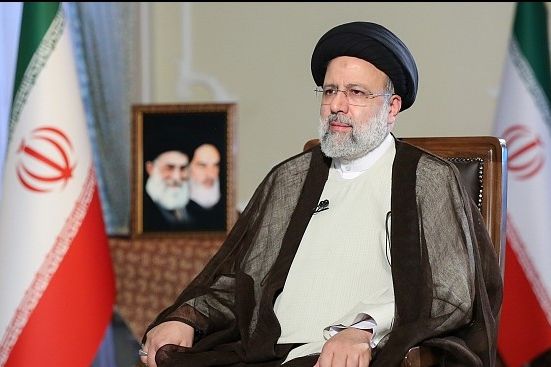
Iran's President Ebrahim Raisi during his TV interview. October 18, 2021
President Ebrahim Raisi should tell the truth to the people instead of giving "formal" television interviews, a well-known conservative newspaper has said.
The Islamic Republic newspaper (Jomhouri-ye Eslami), enjoying close connections with the office of Supreme Leader Ali Khamenei, in an editorial note wrote that there is a lot to say about an October 18 interview by state television with Raisi, but most of all “an interview with the president should not be a formality”.
The paper, established after the revolution in 1979, is managed by Masih Mohajeri, a widely respected veteran cleric known for eschewing factions.
The newspaper noted that despite earlier promises to accept questions from the public, no such opportunity was offered, and the interviewer did not challenge Raisi when he repeatedly blamed the former administration for current problems people face. The paper asked that more than two months have passed since Raisi took office and why there is no positive movement toward solving the economic hardship people face.
Masih Mohajeri, chief editor of 'Islamic Republic' newspaper
Iran’s hardliners were lambasting former president Hassan Rouhani in the media for the deteriorating economic conditions since the United States withdrawal from the Iran nuclear agreement (JCPOA) in 2018. The criticism usually left out the fact that without oil export income constituting half of the government’s budget Rouhani’s hands were tied. The same applies to Raisi.
The Islamic Republic daily wrote that when the price of poultry increased, the state television was attacking Rouhani but now when egg prices have doubled in two months it does not question Raisi.
The paper said that everyone knows the answer as to why egg prices have jumped but Raisi should have been asked about it, so he could have explained that his government is also challenged by the same “external factors”, Rouhani faced, which are beyond the president’s powers to address.
The sharp statement implicitly refers to Iran’s nuclear program and negotiations with the West that have so far not succeeded, leaving the country to struggle amid US sanctions.
The newspaper advised the president “to tell the people the reality, openly and honestly.” In this case, people would welcome his conduct and he would have a better chance of success. In other words, Raisi should come out and admit that US sanctions have led to the serious economic crisis, but the power to change that with a nuclear agreement rests with Khamenei.
Raisi was handpicked by Khamenei to become president after all serious rivals were barred from running in the June election by a constitutional body under the Supreme Leader’s control.
Both before the vote and after assuming office, Raisi has been echoing Khamenei’s slogans for self-sufficiency, and making lofty promises of revolutionary solutions to modern day economic issues. He issues a dozen orders a day for local and national problems to be solved, without saying how his officials can build roads, provide drinking water and electricity or pay workers when there is close to 50-percent budget deficit.
Food prices have jumped 61 percent in Iran in the past 12 months compared with the previous 12-month period, the latest figures published on Saturday show.
The Statistical Center of Iran (SCI), the only government outfit publishing regular inflation and other economic figures, said this was a record inflation rate in Iran.
While overall inflation is more than 45 percent, food prices have soared higher leading to recent local media references to “hidden hunger” among Iranians.
Prices for basic food items, such as cooking oil jumped by 94 percent and dairy products by 71 percent.
Us sanctions since 2018 have deprived the country of oil export revenues forcing a defiant government to print money, fueling inflation and effectively devaluing the national currency. The rial has dropped almost ninefold since late 2017.
Governmental bodies have usually under-reported inflation and unemployment and based on media reports on prices, the real rate of inflation could be much higher than official figures. Earlier this year there were reports of triple-digit rise in food prices.
There are increasing calls from former officials and influential personalities in Iran for the government to act and try to reach an agreement with the United States over Iran’s nuclear program.
An Iranian car factory making older model French cars. December 2019
Iranian President Ebrahim Raisi recently said Iran’s car industry should apply the technology, and show the motivation, developed under sanctions in the arms sector.
"Our military and nuclear industries have been subjected to the worst sanctions, but we have made great achievements because we have acted as if we were doing motivated jihad (effort) to make progress," he said, during a visit to Bushehr province October 8.
Raisi went on to reply to those who he said asked why Iran could build missiles but faced problems with automobiles. "The answer is clear − because we have not invested the technology of the missile industries in the automotive industry.”
Raisi’s comment could have applied to the Soviet Union’s centralized economy where the country could compete with the United States in weapons and space exploration but was unable to produce quality kitchen appliances or cars.
Iran's automotive industry, the county’s largest after oil and gas, employs 700,000. It was valued in 2020 at $26.4 billion by India-based Modor Intelligence, which forecasts 10 percent sectoral annual growth to 2026. This would be possible without sanctions and with new infusion of investments and foreign partnerships. The analysts attributed a recent decline in growth to Covid-19 and United States sanctions.
French companies Peugeot and Citroen withdrew from substantial joint projects in Iran when the US introduced ‘maximum pressure’ sanctions in 2018, but Iran, reports Motor Intelligence, “is taking the necessary actions to boost the production of vehicles and parts locally to meet the demand for vehicles and reduce its import cost.”
Intelligent cars
Speaking to the Iranian Students News Agency (ISNA) Friday, Deputy Chief of Iran's traffic police, Brigadier-General Taymour Hosseini said road accidents were occurring due to inadequate safety standards as Iranian companies struggled to keep up. "Big companies in the world are working on intelligent cars but we have dropped our expectations so much that we are happy with having anti-lock braking systems,” he said.
With around 20,000 annual deaths, Iran has a poor traffic safety record. According to World Health Organization (WHO) data published in 2018, road traffic accidents deaths in Iran reached 21,831 or 6.5 percent of all fatalities.
The WHO said in fact-sheet published in June that93 percentof world road fatalities occurred in low- and middle-income countries, which have only 60 percent of the vehicles. “Road traffic injury death rates are highest in the African region,” with traffic accidents globally “the leading cause of death for children and young adults aged 5-29 years,” the WHO noted.
Iran's trade officials say neighboring Iraq, once along with Syria a thriving market for Iranian vehicles, has rejected Iranian vehicles due to their failure to meet the required standards. Hamid Hosseini, former secretary of Iran-Iraq chamber of commerce told Fararu website that Iraqis were particularly concerned about airbags, fuel consumption and braking systems.
"Special attention should be paid to safety issues and quality if this administration seriously wishes to export automotive products,” Hosseini said. “Otherwise exporting vehicles will not happen," he claimed. Hosseini also said that higher standards in Iraq meant that it would no longer be possible to produce vehicles in Iraq even if US sanctions were lifted.
According to the latest figures, in the past five months Iran has exported only 514 vehicles due to various reasons, including international banking issues resulting from US sanctions.
President Ebrahim Raisi in an interview on Monday insisted the government could phase out cheap dollars for selected imports without "a shock to the market."
An exchange rate of 42,000 rials to the dollar is applied to imports of ‘essential’ commodities while the dollar trades in the open market at over 270,000 rials. The hugely discounted dollar for importers of essential goods was meant to keep down the cost of the commodities facing consumers.
The government's foreign exchange subsidy not only failed to prevent the further fall of the rial or stabilize the market but also it soon became a new problem as allegations of corruption in the distribution of the cheaper dollar began to haunt the government in a matter of months. Much of the valuable was being spent on importing luxury items, from cars to household appliances while subsidized food, medicine, and animal feed was being smuggled out of the country.
Inflation protest near Tehran Bazar in June 2018.
According to the Tasnim news agency, Economy Minister Ehsan Khandouzi this week said the government's economic team was considering allocating the resources currently channeled into supporting essential imports into direct payments to citizens.
Such a move could bolster the ability of recipients to pay higher prices, but economists have argued in recent days that price inflation will accelerate if cheap dollars stop, and the cash handouts would never make up the difference.
That would carry a serious risk of political unrest for the government, as events in November 2019 showed. A sudden hike in gasoline prices led to spontaneous widespread protests. Security forces used military weapons to fire on unarmed protesters, killing hundreds in three days.
The government of President Ebrahim Raisi faces a budget deficit of around $12 billion. A recent report from the Planning and Budget Organizationput Iran’s debt at 30 percent of GDP: this compares to 40 percent in Turkey, 67 percent in Egypt, 117 percent in the US, and 171 percent in Lebanon, but is onerous where denominated in dollars.
Due to demand on foreign exchange − and with the rial at a market rate of 140,000 against the dollar − a meeting of the president with the heads of parliament and judiciary in April 2019 fixed the subsidized rate at 42,000 and limited its allocation to imports such as food and medicine.
The Central Bank, accordingly, constrained the allocation. By July 2021, reports emerged that 1.3 million metric tons of ‘essential’ goods in Iranian ports could not be unloaded because importers lacked dollars to pay foreign vendors.
Sugar was dropped from the list of eligible items in November 2020, while cooking oil remained. Since late March the government has allocated at least $6.9 billion for importing ‘essential’ goods at the set rate, including $1.5 billion for cooking oil.
Nonetheless the price of cooking oil has almost doubled in a year, given rising inflation put at close to 50 percent annually by the Statistical Center of Iran. The IMF projects consumer price inflation of 39 percent in 2021, and 28 percent in 2022.
Power plants in Iran have have switched from natural gas to heavy fuel oils before the peak winter months, in what could lead to heavy pollution in cities.
The head of electricity generation in Iran’s East Azerbaijan province, Mohsen Mousavi told a meeting in the provincial capital Tabriz that the energy ministry ordered them to begin using mazut instead of liquid gas months before Iranian power plants usually do the switch in high-demand winter months.
Iran has been experiencing natural gas shortages to fuel its power plants in cold and hot months. Last winter and early in summer, power plants switched the mazut, which is a dirty diesel fuel. Heavy smog and pollution covered major cities leading to public outcry.
The early use of mazut will inevitably lead to dangerous levels of pollution in major cities, as the cold season is just beginning in Iran and could last until late February. Mousavi said the power plant in Tabriz belongs to a private owner and the government cannot even install equipment to reduce pollution. The plant produces just 300 megawatts of power and a local official said it is not worth endangering the lives of the city’s residents.
For the second time since taking office, President Ebrahim Raisi gave a televised interview Monday to explain how he wants to tackle Iran's economic crisis.
The highlight of what he said was a point that was not new: "I am not going to tie the people's livelihood to the nuclear negotiations."
This has been one of his persisting slogans in recent weeks, meaning Iran will not make concessions to the West to get sanctions relief. Instead, it will try to deal with its economic crisis through self-reliance and closer relations with China and Russia.
Alef wrote: "Some 75 days after taking office as President, still many seats remain vacant in Raisi's administration." Citing the government's own website, Alef wrote that parts of the government including the President's Office and the Interior Ministry still do not have the right officials that can bring about the changes planned by Raisi. The Ministry of Education has still no minister more than a month after the beginning of the new academic year.
First day of school in Iran. September 21, 2021
Alef noted that "the least degree of overhaul has taken place in the economic ministries, where changes are most needed." The website observed that with all the tough economic problems the government faces, there is no one to carry out orders coming from the top.
As an example, according to moderate conservative Khabar Online website, Raisi once again issued orders to three ministries on Tuesday to take measures "to give peace of mind to the people about their livelihood and to put an end to inaction within the government and to sort out the instability in the markets." Like always, Raisi called for "immediate, serious and revolutionary measures" while observers say there is no one to carry out these orders.
Shahrban Amani, Iranian former lawmaker.
In an interview with reformist daily Arman, right-of-center former lawmaker and Tehran City Council member Sharbanu Amani said that the most important problem for Raisi is that his government "has no plans and roadmaps and that is why it seems to be confused about many things."
Ms. Amani charged that neither Raisi, nor his aides have ever told the people about the details of their plans for solving the country's problems. She added that "although Raisi has been part of the Iranian government for at least 40 years, he still does not have a full team to support him. There was no team even when he was running for the office."
The outspoken politician said: "Raisi was elected in an extremely low-turnout election. He was expected to be in a hurry to seek the nation's support by acting quickly to solve problems. But we see that he has set up one of the weakest administrations in Iran when we look at his top officials. Most of his managers, who are mainly the former aides of Mahmoud Ahmadinejad, look at problems from a military and security perspective. This comes while we expected him to behave in a way that would return the public's trust in the government."
Amani said Raisi may find it difficult to restore public trust. In his visit to Bushehr Province, he asked the local governor to solve long-standing problems within ten days while everyone knows that would be impossible as economic problems cannot be solved by issuing orders.
Ms. Amani warned that Iran's economic crisis is serious, yet, the Raisi administration has not taken any positive step to solve Iran’s nuclear dispute and help lift sanctions, while the Covid pandemic is also taking its toll. The parliament, packed by hardliners, which was supposed to help the likeminded president has done nothing. In the meantime, useless decisions such as a planned 20-year deal with Venezuela, a country with its own severe economic crisis is questionable. Selecting Mohammad Eslami as nuclear chief and Hossein Amir-Abdollahian as Foreign Minister were also wrong decisions. They do not know the basics of their job, she maintained.
However, Ms. Amani said: We cannot blame Raisi for all the problems. Those who omitted all other candidates and narrowed down the people's choice to Raisi are also to be blamed for the situation.