• العربية
  • فارسی
Brand
  • Iran Insight
  • Politics
  • Economy
  • Analysis
  • Special Report
  • Opinion
  • Podcast
  • Iran Insight
  • Politics
  • Economy
  • Analysis
  • Special Report
  • Opinion
  • Podcast
  • Theme
  • Language
    • العربية
    • فارسی
  • Iran Insight
  • Politics
  • Economy
  • Analysis
  • Special Report
  • Opinion
  • Podcast
All rights reserved for Volant Media UK Limited
volant media logo

Grossi's Meeting With US Senators Focuses On Iran
Iran International Newsroom
Oct 20, 2021, 09:47 GMT+1Updated: 17:23 GMT+1
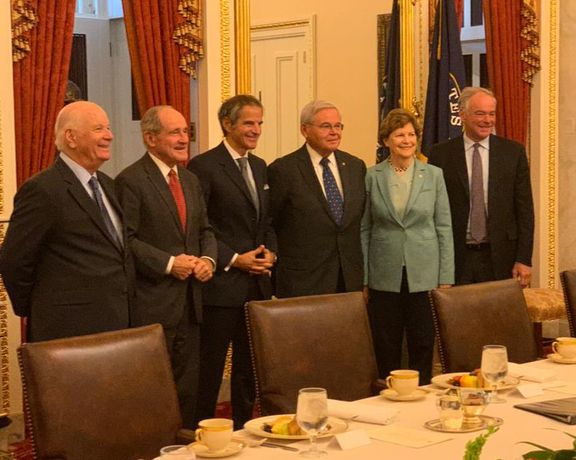
IAEA's Rafael Grossi meeting members of the US Senate Foreign Relations Committee. October 19, 2021

A meeting on Tuesday between the head of the UN nuclear watchdog Rafael Grossi and members of the US Senate Foreign Relations Committee focused on Iran.

A day after meeting Secretary of State Antony Blinken, Grossi was invited to the Senate by Chairman of the Committee Sen. Bob Menedez, where around a dozen Senators had an opportunity to discuss Iran’s lack of full cooperation with the International Atomic Energy Agency (IAEA), with director general Grossi.

Senator Jim Risch (R-Idaho) issued a statement after the meeting saying, “Iran continues to steadily advance its nuclear program, while violating its international obligations and preventing the IAEA from fulfilling its monitoring responsibilities. Its failure to provide credible answers to the IAEA’s questions regarding its undeclared nuclear sites is unacceptable. Today, I thanked Director General Grossi for his strong leadership in pursuing the IAEA’s investigation into these sites, and urged him to continue to press Iran until it provides all required information.”

Senator Jim Risch greeting Rafael Grossi. October 19, 2021
100%
Senator Jim Risch greeting Rafael Grossi. October 19, 2021

Republicans who have been sceptical of the Biden Administration’s diplomatic approach to Iran and have repeatedly urged not to make concessions to Tehran see the lack of cooperation with IAEA as proof that the Islamic Republic cannot be trusted.

In the September IAEA Board of Governors meeting, Grossi had already issued a report accusing Iran of lack of cooperation both in accounting for its past nuclear activities and also in current monitoring efforts by UN’s nuclear watchdog. However, the United States and its European allied known as E3 decided not to pursue a resolution to condemn Iran.

Senator Risch in his statement demanded a tougher approach in the next board meeting. “I also stressed the importance of taking strong action in advance of the November Board of Governors meeting, and to prepare to censure and refer Iran. President Biden should finally recognize that Iran is not interested in any agreement that would protect the interests of the United States and our allies. The…legitimacy of the IAEA depends on strong U.S. leadership in seeking accountability for Iran’s nuclear activities, and in pressuring Iran to fulfil its obligations to the international community.”

In a tweet the Senator also thanked Grossi for his “leadership in IAEA’s investigation” and the need “to hold Iran accountable”.

On Monday, Grossi in an interview with the Financial Times stressed that he needs to visit Iran again and have an urgent meeting “at the political level”, meaning with Foreign Minister Hossein Amir-Abdollahian. In his previous trip in September Grossi met with Iran’s nuclear chief Mohammad Eslami, who is also vice president to Ebrahim Raisi.

Grossi told the Financial Times that a temporary arrangement for the International Atomic Energy Agency (IAEA) to monitor Iran’s nuclear sites was no longer “intact.” Iran restricted IAEA’s monitoring in February after its parliament passed a law demanding the lifting of US sanctions or reduced Iranian cooperation.

IAEA access in Iran is currently under a temporary arrangement reached September 12, but Grossi has expressed concern at Iran’s decision September 16 not to allow the changing of memory cards of monitoring cameras at the Tesa Karaj site, where Iran makes centrifuges used for enriching uranium.


Most Viewed

Ideology may be fading in Iran, but not in Kashmir's ‘Mini Iran'
1
INSIGHT

Ideology may be fading in Iran, but not in Kashmir's ‘Mini Iran'

2
INSIGHT

Hardliners push Hormuz ‘red line’ as US blockade tests Iran’s leverage

3
VOICES FROM IRAN

Hope and anger in Iran as fragile ceasefire persists

4

Iran International says it won’t be silenced after London arson attack

5

US sanctions oil network tied to Iranian tycoon Shamkhani

Banner
Banner

Spotlight

  • Hardliners push Hormuz ‘red line’ as US blockade tests Iran’s leverage
    INSIGHT

    Hardliners push Hormuz ‘red line’ as US blockade tests Iran’s leverage

  • Ideology may be fading in Iran, but not in Kashmir's ‘Mini Iran'
    INSIGHT

    Ideology may be fading in Iran, but not in Kashmir's ‘Mini Iran'

  • War damage amounts to $3,000 per Iranian, with blockade set to add to losses
    INSIGHT

    War damage amounts to $3,000 per Iranian, with blockade set to add to losses

  • Why the $100 billion Hormuz toll revenue is a myth
    ANALYSIS

    Why the $100 billion Hormuz toll revenue is a myth

  • US blockade targets Iran oil boom amid regional disruption
    ANALYSIS

    US blockade targets Iran oil boom amid regional disruption

  • Iran's digital economy battered by prolonged blackout
    INSIGHT

    Iran's digital economy battered by prolonged blackout

•
•
•

More Stories

UN Nuclear Chief Grossi Wants ‘Political Level’ Meeting In Tehran

Oct 19, 2021, 17:56 GMT+1
•
Iran International Newsroom

The head of the UN atomic inspection agency said Tuesday he was expecting news on when he would visit Iran to resume talks over access to nuclear sites.

Rafael Mariano Grossi told the Financial Times Monday during a trip to Washington that a temporary arrangement for the International Atomic Energy Agency (IAEA) to monitor Iran’s nuclear sites was no longer “intact.”

Grossi told the newspaper he wanted an urgent meeting − “contact at the political level” − with Iran’s foreign minister Hossein Amir-Abdollahian to discuss surveillance arrangements. This reiterated Grossi’s request aired on the BBC Hardtalk program broadcast September 29 to meet with Amir-Abdollahian or President Ebrahim Raisi (Raeesi).

Cameras at Karaj?

Agency access in Iran is currently under a temporary arrangement reached September 12, but Grossi has expressed concern at Iran’s decision September 16 not to allow the changing of camera memory cards at the Tesa Karaj site, where Iran makes centrifuges used for enriching uranium. Iran says it is carrying out security investigation at the site following a June attack widely blamed on Israel.

The September 12 agreement extended the February arrangement Grossi reached after Iran reduced IAEA access to the basic level required under the Nuclear Non-Proliferation Treaty.The September agreement allowed the agency to replace camera memory cards, enabling it potentially to later “reconstruct” activities in Iran’s nuclear program.

But this in turn would require a wider agreement over restoring Tehran’s 2015 nuclear agreement with world powers, the JCPOA (Joint Comprehensive Plan of Action), which both limited Tehran’s nuclear activities and allowed the IAEA greater inspection access.

Raisi said Monday that Iran was serious about continuing talks in Vienna aimed at reviving the JCPOA but he gave no date for their resumption. There are increasing concerns in Europe and the United States that Tehran is gaining nuclear experience and perhaps trying to strengthen its negotiating position.

As Grossi met US Secretary of State Antony Blinken Monday, State Department spokesman Ned Price said the US did not see any need for an “intermediate” meeting between Iran and three European powers in Brussels, as was agreed by European Union foreign policy chief Enrique Mora in Tehran September 14.

Iran using Europe?

Some analysts suggest Tehran may see the three European JCPOA signatories – France, Germany, and the United Kingdom, the ‘E3’ – as a means to exert pressure on the US. Washington, which left the JCPOA in 2018, has taken part indirectly in the Vienna process, which are formally between the E3, Iran, China and Russia.

The Vienna talks, which began in April with the new US administration of President Joe Biden expressing a desire to revive the JCPOA, struggled to agree which US sanctions violate the agreement and exactly how the expanded and improved Iran nuclear program should be returned to JCPOA limits.

Grossi stressed to Hardtalk last month the link between inspections and the Vienna efforts to restore the JCPOA. “We are the guarantors…of whatever is agreed,” he said, noting that further limiting access “could mean we would start losing ground and start losing the capability to know exactly what is happening to the last detail…”

In his FT interview, Grossi said the current inspection arrangement was “seriously affected” and “not intact” while “not valueless either.” The IAEA board has a quarterly meeting in November, where pressure on Iran may build.

Israeli defense minister Benny Gantz, appearing before a parliamentary committee, cited Tuesday Iran’s nuclear program as justifying an increased defense budget. Israel’s channel 12 television reported Monday that $1.5 billion would be allocated for weapons to confront Iran. Israel is keen to procure US ‘bunker-buster’ bombs.

Israel's Defense Minister Asks For Higher Budget, Citing Iran

Oct 19, 2021, 16:51 GMT+1

Israeli Defense Minister Benny Gantz has appeared before a key Knesset committee to argue for a higher defense budget, citing Iran as the major threat.

Gantz said the most significant threat Israel faces is Iran and its nuclear program, adding the armed forces need the means to confront the danger.

“We see that Iran is advancing toward the level of enrichment that would allow it, when it wished, to become a threshold state — and we are making every effort to prevent that. We will invest in our offensive and defensive capabilities, improve our technological superiority, and accelerate our efforts to ensure that — even though Iran is foremost a global and regional challenge — Israel will always have the ability to defend its citizens with its own forces,” The Times of Israel quoted him as saying.

Israel’s channel 12 reported Monday that a budget of roughly $1.5 million is being allocated to procure the necessary weapons to confront Iran if it refuses to return to nuclear talks with Western powers.

Gantz also said that a higher budget is needed for a two-front war, a possible reference to a conflict with Palestinian groups in Gaza or with the Lebanese Hezbollah, both backed by Tehran.

Israel Reportedly Prepares For A Potential Strike At Iran Nuclear Sites

Oct 19, 2021, 08:27 GMT+1
•
Iran International Newsroom

With Iran nuclear talks stalled, Israel reportedly appropriated $1.5 billion to prepare for a potential strike at Iran, as US tested a new bunker-buster bomb.

Israel’s Channel 12 reported Monday that the additional money set to be approved by the government in November, would pay for aircraft, intelligence-gathering drones and armaments needed for a strike against hardened Iranian nuclear targets.

US officials, including Secretary of State Antony Blinken have mentioned “other options” if Iran refuses to return to nuclear talks. Tehran suspended the Vienna negotiations in June after the election of Ebrahim Raisi (Raeesi), a hardliner handpicked by Supreme Leader Ali Khamenei.

Although ‘other options’ could mean taking Iran’s case to the UN Security Council for imposing international sanctions, or simply augmenting US sanctions, Israel has been much more adamant that Tehran’s nuclear program should be stopped at any cost. Estimates vary about when Iran could reach the nuclear threshold for a bomb, but both the West and regional countries are concerned that Tehran is building up its stockpile of enriched uranium, while refusing to negotiate.

The US GBU-72 Advanced 5K Penetrator 5,000 pound bomb.
100%
The US GBU-72 Advanced 5K Penetrator 5,000 pound bomb.

Israeli officials have warned on several occasions since August that if no options are left they would "go it alone" to stop Iran from acquiring nuclear weapons. That could mean that Israel might not even tolerate Iran becoming a "threshold state", meaning having all the components for a bomb but not actually deploying one.

The US Air Force reported on October 13 that a new 5,000-pound bunker-buster munition was successfully tested by an F-15E Strike Eagle warplane on October 7. This means that the bomb can be launched from fighter planes and could be potentially used by Israel. The GBU-72 Advanced 5K Penetrator was released from 35,000 feet and hit a designated area “surrounded by blast pressure sensors and fragment-counting equipment,” which helps to determine the weapon’s lethality, the Air Force said.

Channel 12 speculated that the US Air Force test was meant to be a warning to Iran not to avoid the nuclear talks. Last week, Iran said it wants to hold discussions with the European Union in Brussels before any return to the main nuclear negotiations, but the State Department on Monday dismissed the idea, saying such talks are not needed. Apparently, Tehran wanted to start a new negotiating tactic that would exclude Washington. In the Vienna Talks the US was present and negotiated indirectly with Iran.

Any conflict with Iran could easily escalate into a separate war with the Lebanese Hezbollah Shiite militant group. A senior Israeli military official said on Monday that Hezbollah can fire 2,000 rockets a day at Israel if conflict breaks out. The group’s leader Hassan Nasrallah also warned his opponents in Lebanon that it has 100,000 fighters, after a brief gun battle in Beirut last week.

US Says Additional Nuclear Talks In Brussels Not Necessary

Oct 18, 2021, 20:53 GMT+1

Talks in Brussels are not necessary before the resumption of indirect nuclear talks with Iran in Vienna, State Department spokesperson Ned Price said Monday.

Reference to possible talks in Brussels with the EU emerged after the visit of European Union's chief negotiator Enrique Mora to Tehran on October 14.

Reports in Iranian media on Sunday suggested a possible meeting in Brussels, but the European Union's foreign policy chief Josep Borrell played down the chance of any talks outside of Vienna earlier on Monday.

Iran has said it wants to review documents from the first six rounds of talks with EU in Brussels, but that would not be different from negotiations and would effectively leave Washington out of the process for an agreement to revive the Joint Comprehensive Plan of Actions, JCPOA.

Iran has been refusing to return to the Vienna talks that began in April and were suspended in June when Tehran said its new president needed time to form a government. In the meantime, Iran continues to enrich uranium up to 60 percent, getting closer to having enough fissile material for a bomb.

Iran's Raisi Demands US Lift Sanctions For Talks To Continue

Oct 18, 2021, 20:24 GMT+1

Iran's hardline President Ebrahim Raisi said on Monday that the US should lift sanctions, as Tehran has refused to return to nuclear talks since in June.

"We are serious about result-oriented negotiations. ... If Americans are serious, they should remove unjust sanctions on Iran," Raisi told state TV.

In April, Iran and six powers started talks to reinstate the deal that then-US President Donald Trump ditched three years ago and reimposed sanctions that have squeezed Iran's oil exports.

The talks in Vienna were meant to agree on a process for both sides to return to the 2015 agreement (JCPOA), which would involve lifting of US sanctions, and for Iran stopping violations of the deal.

But the talks were put on hold after Raisi's election in June. Western powers have urged Iran to return to negotiations, warning that time is running out as Tehran's nuclear program is advancing well beyond limits of the nuclear pact.

In response to Trump's reimposition of sanctions, Tehran has breached the deal by rebuilding stockpiles of enriched uranium, refining it to higher fissile purity and installing advanced centrifuges to speed up output.




