• العربية
  • فارسی
Brand
  • Iran Insight
  • Politics
  • Economy
  • Analysis
  • Special Report
  • Opinion
  • Podcast
  • Iran Insight
  • Politics
  • Economy
  • Analysis
  • Special Report
  • Opinion
  • Podcast
  • Theme
  • Language
    • العربية
    • فارسی
  • Iran Insight
  • Politics
  • Economy
  • Analysis
  • Special Report
  • Opinion
  • Podcast
All rights reserved for Volant Media UK Limited
volant media logo

Iran Minister Rules Out Digging Wells Near Cyrus Tomb
Oct 18, 2021, 19:45 GMT+1
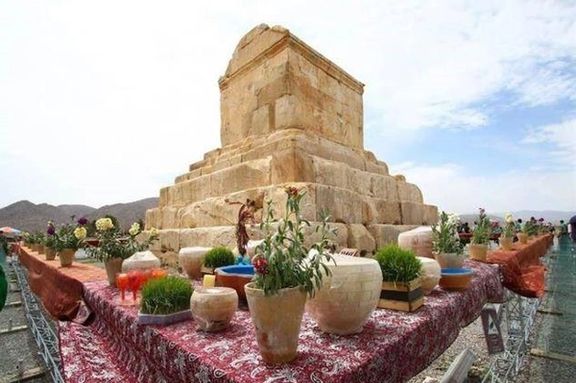
Iranians visiting Cyrus the Great's tomb bringing flowers and plants. Undated

Iran's cultural heritage minister, denied Sunday there was any plan to dig agricultural wells near the tomb of Cyrus the Great in the ancient Achaemenid site, Pasargadae.

Ezzatollah Zarghami told reporters on the sidelines of an exhibition that the government wanted to address farmers’ problems but would not allow wells near the historic monument dating from the 6th-century BC. Zarghami said he had been misunderstood by critics since he said last week, on a visit to the Unesco World Heritage site of Pasargadae, that that the issuing of well permits needed to be reviewed, given problems of irrigating land.

"Zarghami has backtracked and denied his previous remarks about agriculture in Pasargadae and like other authorities has claimed that his remarks were distorted,” the reformist Aftab-e Yazd newspaper said Sunday.

Etemad newspaper wrote in a commentary Sunday that studies had shown “the only way to save Pasargadae is to shut down wells,” while the minister had defended the “extraction of water within the limits of historical monuments instead of worrying about…wells and limitless water extraction."

Iran's cultural heritage minister visiting the tomb of Cyrus the Great. October 14, 2021
100%
Iran's cultural heritage minister visiting the tomb of Cyrus the Great. October 14, 2021

President Ebrahim Raisi (Raeesi) last week visited the ruins at Persepolis, the ceremonial capital of the Achaemenid Empire close to Pasargadae. Raisi said the palace complex was both a relic of Iranian art and "a message to oppressors to behold the fate of those who oppress the people."

Raisi critics have slammed the idea that the Achaemenids were "oppressors" and accused the president of undermining national identity. Persepolis and Pasargadae were both destroyed by Alexander the Great after the Achaemenid empire collapsed to the Greeks, Macedonians and their allies in 330 BC, some 200 years after the empire was founded in the 6th century BC by Cyrus.

The Achaemenid empire, which was strictly hierarchical and covered a variety of ethnic groups under the Persians, is minimally represented in school history books in Iran.Persepolis was a “dynastic, perhaps ritual, center,” wrote historian Richard Frye, where the priestly caste was influenced by the teachings of Zoroaster.

“Raisi and Zarghami's remarks showed they have no knowledge of and no interest in Iran's ancient history,” Morteza Kazemian, Iran International analyst, said Sunday. "They don't relate to that history and the symbols of Iranian identity in any way."

Esmail Kahrom, an environmentalist known internationally for his jointly edited book The Lion and the Gazelle, has warned that Cyrus tomb could sink into land holes caused by water extraction 40 years from now if agriculture expands. Kahrom, a former adviser to the head of the department of environment, has argued the local economy should rely on expanding tourism.

Kahrom has drawn a comparison to the historic Khajou Bridge in Esfahan, where the transfer of water from Zayandeh Roud to other provinces, and for use in agriculture and industry, has dried up the river over 20 years and led to cracks in the surrounding groundand the bridge’s structure.

There is also land subsidence at Esfahan’s airport, historic monuments, and residential and commercial buildings. Experts say Iran has under ten years to deal with land subsidence.


Most Viewed

State media slam Araghchi's Hormuz tweet, say it let Trump claim victory
1

State media slam Araghchi's Hormuz tweet, say it let Trump claim victory

2
OPINION

The Hormuz get out of jail card turned to a grave

3

Iran International says it won’t be silenced after London arson attack

4
INSIGHT

How Tehran bends its own red lines to boost state rallies

5

Iran halts petrochemical exports to supply domestic market

Banner
Banner

Spotlight

  • Too early to tell who is winning Iran war, experts say
    PODCAST

    Too early to tell who is winning Iran war, experts say

  • How Tehran bends its own red lines to boost state rallies
    INSIGHT

    How Tehran bends its own red lines to boost state rallies

  • Iran blackout cripples freelancer, small business incomes
    VOICES FROM IRAN

    Iran blackout cripples freelancer, small business incomes

  • Ideology may be fading in Iran, but not in Kashmir's ‘Mini Iran'
    INSIGHT

    Ideology may be fading in Iran, but not in Kashmir's ‘Mini Iran'

  • US blockade enters murky phase as tankers spoof signals and buyers hesitate
    ANALYSIS

    US blockade enters murky phase as tankers spoof signals and buyers hesitate

  • Why the $100 billion Hormuz toll revenue is a myth
    ANALYSIS

    Why the $100 billion Hormuz toll revenue is a myth

•
•
•

More Stories

Iran Speaks Of An Upcoming 20-Year Cooperation Deal With Venezuela

Oct 18, 2021, 13:33 GMT+1

Iran’s foreign minister has said a 20-year cooperation agreement will be concluded with Venezuela during Nicolas Maduro’s trip to Iran in the coming months.

Hossein Amir Abdollahian spoke of the agreement during a joint press conference in Tehran with visiting Venezuelan foreign minister Felix Plasencia on Monday. He added that “We agreed to prepare a 20-year roadmap for cooperation between Tehran and Caracas.”

Iran has prepared a similar document with China, with its contents remaining obscure, which is a roadmap of expanded relations rather than a concrete bilateral treaty.

Amir-Abdollahian said a joint commission will prepare the document before Maduro’s trip to Iran.

While both countries are under heavy US sanctions which have pushed their economies into serious crises, Amir-Abdollahian spoke about Iranian goods being sold in Venezuela and investments opportunities in Iran.

President Ebrahim Raisi, who met with the Venezuelan foreign minister said later that Latin America “is a priority in Iran’s economic diplomacy” and a long-term plan must be prepared to “boost relations” to the maximum degree possible.

Plasencia said during the press conference that his trip to Tehran was his first foreign visit since he was named foreign minister in August.

Europe, Iran Inch Towards Brussels Talks About Talks

Oct 18, 2021, 12:53 GMT+1
•
Iran International Newsroom

In confirming Monday their diplomats would meet in Brussels to review Iran’s stalled nuclear talks, EU foreign policy chief and Iran’s foreign ministry did not name a day.

For the European Union, Josep Borrell declined to confirm reports − citing an Iranian parliamentarian − that the meeting would be Thursday.

In Tehran, Saeed Khatibzadeh, spokesman of the foreign ministry, said that after a “constructive” visit last Thursday by Enrique Mora, the EU political director who coordinates the Vienna talks, Iran’s discussions with Europe would “continue in a few days in Brussels.”

The Vienna talks began in April but were suspended in June pending the Iranian presidential election and transition, but since then Iran has refused to return to negotiations. Aiming to restore Iran’s 2015 nuclear deal with world powers (the JCPOA, Joint Comprehensive Plan of Action), the talks failed to agree which United States sanctions needed to be lifted for Washington to return to the deal, which it left it 2018, and how Iran should bring its nuclear program back within JCPOA limits.

Neither the EU nor Iran has explained why they intend to liaise in Brussels. The Vienna talks formally involve all remaining parties to the JCPOA – China, France, Germany, Iran, Russia, and the United Kingdom – with the US taking part indirectly.

Asked about the future of the process as he arrived for an EU foreign ministers meeting in Luxembourg Monday, Borrell said he was “more optimistic today than yesterday.”

"No confirmation yet, but things are getting better and I am hopeful we will have preparatory meetings in Brussels in the days to come," he said.

New arrangement

In Tehran Khatibzadeh confirmed that the foreign ministry would continue to lead Iran’s diplomacy on the nuclear issue but with “a new arrangement.”

Asked if Ali Bagheri-Kani would take over the role as lead negotiator of Abbas Araghchi, whom he has replaced as a deputy foreign minister under President Ebrahim Raisi (Raeesi), Khatibzadeh confirmed Bagheri-Kani would lead the Iranian side in Brussels.

“Mr Bagheri will in his first opportunity present his views [opinions] to the European side,” Khatibzadeh explained.

A growing sense of urgency in European over the negotiations result results partly from concerns that the Raisi administration, which includes long-term critics of the JCPOA, will toughen Iran’s approach and partly from the experience Iran is gaining with an expanded nuclear program, which could undermine the non-proliferation calculations underpinning the 2015 agreement.

Khatibzadeh insisted that the onus in the nuclear talks lay in Washington. He also expressed Iran’s concerns over the value of any US commitments, given previous US president Donald Trump left the JCPOA unilaterally in 2018 and imposed ‘maximum pressure’ sanctions.

“All talk has been aimed at bringing back the US without preconditions to commitment to 2231,” he said, citing the United Nations Security Council resolution that endorsed the JCPOA.

“Our main goal is to make sure that all sanctions are ended and that decisions cannot be changed by anyone in Washington and there will be no games played against us. This can be achieved only in concrete talks.”

Discussions in Brussels, the spokesman said, would consider “the challenges and obstacles that were not bought to a conclusion (resolved) in Vienna.”

Ahmadinejad Ends Dubai Trip Early After It Kicks Up Storm In Tehran

Oct 18, 2021, 11:44 GMT+1
•
Maryam Sinaiee

Mahmoud Ahmadinejad ended his Dubai trip on Sunday after the Iranian Consulate prevented him from holding a press conference, sources told Iran International.

Officials blocked reporters entering the venue, the Iranian Club Dubai, the sources in the United Arab Emirates said. The Iranian Club Dubai is a luxury hospitality center belonging to the state-affiliated ‘charitable’ Mostazafan Foundation. Later in the evening Ahmadinejad returned to Tehran prematurely.

This was the former president's first visit abroad since his second term ended in 2013. Media supporting Ahmadinejad had said that he was going to visit Expo 2020, a trade fair.

Principlist media claimed that Ahmadinejad had been deported by UAE police. It had become clear he was up to "political games and populist activities" that would undermine Expo 2020, Jahan News wrote Monday.

The reason for his early departure is not clear. It could have been a request by Emirati authorities or an order from Tehran for him to return.

The Revolutionary Guards-affiliated Fars news agency Sunday called Ahmadinejad's trip a "desperate attempt to be seen" that ended when he was "advised by UAE authorities" to return to Tehran.

Ahmadinejad's trip was well publicized by supporters and had sparked speculation a foreign travel ban had been lifted. Ahmadinejad criticized Supreme Leader Ali Khamenei for calling the June 18 presidential election an "epic" event, after he was barred from the poll. Ahmadinejad’s presidency saw him disagree with Khamenei, notably when heboycotted government meetingswhen the leader insisted that Heydar Moslehi remain intelligence minister.

Ahmadinejad gave an interview in Dubai to Independent Persian website covering relations with the United States, the Taliban, Saudi Arabia, the nuclear issue, Syria, and Yemen.

In the interview Ahmadinejad said he would not call himself an opposition figure. "I'm an Iranian and like any other Iranian I have a right to live and to express my views," he said. "If now someone is sitting at the head of the state, the country is not his, the country belongs to everyone and everyone has a right to express their views.”

In a video taken at Tehran's International Imam Khomeini Airport after his return, Ahmadinejad said he had intended to stay in Dubai three days but had extended his visit for two more. He promised "a full report” on his visit.

Some Iranian media last week published photos of Ahmadinejad with a woman claiming it was taken at the Israeli pavilion at the trade fair, while pro-Ahmadinejad media denounced this as a trick to tarnish Ahmadinejad's image. "Whoever says Ahmadinejad visited the Zionist regime's pavilion is a Mossad agent," Mohammad-Hossein Heydari, a pro-Ahmadinejad journalist tweeted.

Pro-Ahmadinejad lawmaker Ahmad Alireza-Beigi, who accompanied him to Dubai, dismissed an attempt to mislead the public. "The publication of this type of misinformation proves that Ahmadinejad's international popularity has worried those who lack such popularity and don't have similar travel chances," he said.

Iran Says Talks With Saudi Arabia Are 'Cordial, Important And Positive'

Oct 18, 2021, 10:04 GMT+1

Iran’s foreign ministry spokesman, Saeed Khatibzadeh has said on Monday that talks with Saudi Arabia “have been cordial and to the same degree serious”.

Khatibazadeh who was speaking to reporters during his weekly briefing, said that so far four rounds of negotiations have been held in Iraq and “talks have taken place in a friendly and positive atmosphere.”

Saudi Arabia and Iran severed diplomatic ties in January 2016 when mobs attacked and ransacked the Saudi embassy in Tehran and its consulate in Mashhad.

Riyadh later supported former US president Donald Trump’s decision to withdraw from the 2015 nuclear deal (JCPOA) and impose tough sanctions on Tehran.

Khatibzadeh did not offer any details to reporters but said that talks should be allowed to proceed at the negotiating table. He denied reports that a Saudi delegation might soon visit Iran.

Iran has so far presented a more optimistic picture of the talks while Saudi Arabia has said they have been “exploratory”.

The United States and its European allies who have been holding talks with Iran over its nuclear program have also raised the issue of Iran’s interventionist policies in the region. Iran might be interested to present its talks with Saudi Arabia as a counterweight to their arguments.

Iran's Riaisi Appoints More IRGC Commanders To Civilian Positions

Oct 18, 2021, 09:12 GMT+1

Iran’s President Ebrahim Raisi (Raeesi), in a rare move, has appointed two active-duty Revolutionary Guard commanders as governors in two key provinces.

In a decision of the cabinet on Sunday Abedin Khorram, Islamic Revolution Guard Corps (IRGC) commander in Eastern Azerbaijan was appointed governor of same province. Also, Yaghubali Nazari, IRGC commander in Khorasan-Razavi province became governor of the same province.

Raisi’s move in effect changed the civilian governorship in the two provinces into military governorship, since both IRGC officers were commanders in the same provinces, although they might be replaced as military commanders in the two provinces.

Islamic Republic presidential administrations and state entities have routinely given civilian positions to less active or former IRGC senior commanders but appointing active-duty military commanders directly to top civilian positions within the jurisdiction of their own commands has been rare.

IRGC's Abedin Khorram, appointed governor by Raisi.
100%
IRGC's Abedin Khorram, appointed governor by Raisi.

Dozens of IRGC officers also swept into the parliament in the February 2020 elections, when hundreds of reformist candidates were barred from running, and with a very low voter turnout, hardliners and IRGC officers won an overwhelming majority.

Khorram was previously IRGC commander in Khoi and deputy commander and commander in Western Azerbaijan. Fars news agency affiliated with IRGC had earlier mentioned him as a veteran of the Syrian war, where Iran has deployed an array of forces since 2011 to defend Bashar al-Assad’s rule.

Nazari commanded IRGC forces in Khorasan-Razavi province for the past six years before being appointed as governor.

Raisi has already appointed several former IRGC officers as ministers in his cabinet and top managers in other positions throughout the government. One of his main economic aides is Mohsen Rezaei, a former top IRGC commander who has no experience as an economic manager.

Another military officer appointed as governor by Raisi is Ahmad Mohammadizadeh, who was the head of IRGC’s ‘strategic center for management and command’ and is now governor of Bushehr province.

Raisi’s agriculture minister Mohammad Sadatinejat also issued an order appointing the former commander of IRGC in Tehran, Mohsen Kazemeini to a special branch of the ministry in charge of food supply security. He was commander of the ‘Mohammad Rassoul Allah’ division in Tehran which plays the most critical role among all IRGC forces to protect and defend the regime against protests.

The policy of hardline supporters of Supreme Leader Ali Khamenei, backed by IRGC, in pushing many other loyal regime elements to the margins of politics has opened more vistas for Revolutionary Guard officers. The military force already is perhaps the biggest economic actor in Iran with hundreds of companies in all sectors.





