• العربية
  • فارسی
Brand
  • Iran Insight
  • Politics
  • Economy
  • Analysis
  • Special Report
  • Opinion
  • Podcast
  • Iran Insight
  • Politics
  • Economy
  • Analysis
  • Special Report
  • Opinion
  • Podcast
  • Theme
  • Language
    • العربية
    • فارسی
  • Iran Insight
  • Politics
  • Economy
  • Analysis
  • Special Report
  • Opinion
  • Podcast
All rights reserved for Volant Media UK Limited
volant media logo

France Says EU Visit To Iran Critical To Future Of Nuclear Talks
Oct 13, 2021, 14:49 GMT+1
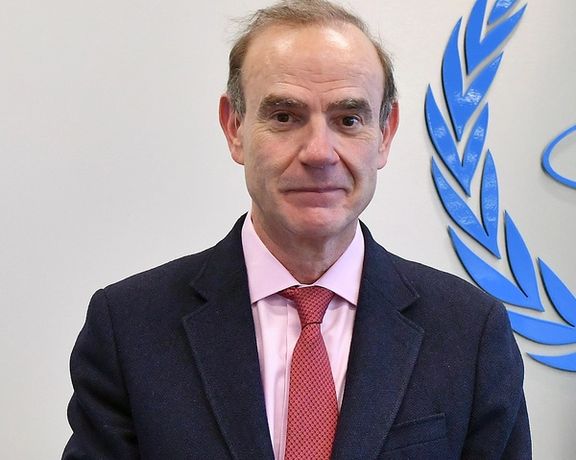
Enrique Mora, EU's lead negotiator in Iran nuclear talks. FILE PHOTO

A pending visit to Tehran by the European Union's coordinator for talks to revive the Iran nuclear deal is vital to its future, France said on Wednesday.

The French foreign ministry also questioned the new hardline Iranian administration's commitment to salvaging the pact.

Enrique Mora, the EU's political director and EU coordinator in nuclear talks with Iran, is due to hold talks on Thursday with members of Iran's nuclear negotiating team almost four months after talks stalled between Iran and world powers, including the United States, to revive the 2015 deal.

"Through its statements and actions on the ground, the new Iranian administration of President (Ebrahim) Raisi raises doubts about its intention to return to the Joint Comprehensive Plan of Action (JCPoA)," French Foreign Ministry spokeswoman Anne-Claire Legendre told reporters in a daily online briefing.

"While refusing to negotiate, Iran creates facts on the ground that further complicate the return to the JCPoA. It is therefore in a context of crisis and at a critical moment for the future of the nuclear agreement that this trip by...Mora to Tehran takes place."

The Islamic Republic has repeatedly said it will return to the negotiations "soon" without giving any sense of what that actually means. Western diplomats have tentatively said a return to the Vienna talks may be possible before the end of October.

Legendre added that Tehran would also need to be clear about its intentions should it come back to the talks.

Since then-US President Donald Trump ditched the deal in 2018 and reimposed sanctions on Iran, Tehran has been rebuilding stockpiles of enriched uranium, refining it to higher levels of fissile purity, and installing advanced centrifuges to speed up production.

President Joe Biden aims to restore the deal but the sides disagree on which steps need to be taken and when.

Key issues include what nuclear limits Tehran will accept, what sanctions Washington will remove, whether there will be any guarantees and the prospect of follow-on talks on Iran's future nuclear program, regional and ballistic missile activities, diplomats have said.

"In line with recent regional and international consultations, I will host @eu_eeas Deputy Secretary General @enriquemora_ on Thursday," Iranian Deputy Foreign Minister Ali Bagheri Kani, who is expected to lead Iran's new negotiating team, said in a Twitter post on Wednesday.

"Exchanging views on bilateral & regional issues including Afghanistan, as well as talks on removal of cruel sanctions, are on the agenda."


Most Viewed

Hardliners push Hormuz ‘red line’ as US blockade tests Iran’s leverage
1
INSIGHT

Hardliners push Hormuz ‘red line’ as US blockade tests Iran’s leverage

2

Iran International says it won’t be silenced after London arson attack

3
VOICES FROM IRAN

Hope and anger in Iran as fragile ceasefire persists

4

US sanctions oil network tied to Iranian tycoon Shamkhani

5

Iran halts petrochemical exports to supply domestic market

Banner
Banner

Spotlight

  • Hardliners push Hormuz ‘red line’ as US blockade tests Iran’s leverage
    INSIGHT

    Hardliners push Hormuz ‘red line’ as US blockade tests Iran’s leverage

  • Ideology may be fading in Iran, but not in Kashmir's ‘Mini Iran'
    INSIGHT

    Ideology may be fading in Iran, but not in Kashmir's ‘Mini Iran'

  • War damage amounts to $3,000 per Iranian, with blockade set to add to losses
    INSIGHT

    War damage amounts to $3,000 per Iranian, with blockade set to add to losses

  • Why the $100 billion Hormuz toll revenue is a myth
    ANALYSIS

    Why the $100 billion Hormuz toll revenue is a myth

  • US blockade targets Iran oil boom amid regional disruption
    ANALYSIS

    US blockade targets Iran oil boom amid regional disruption

  • Iran's digital economy battered by prolonged blackout
    INSIGHT

    Iran's digital economy battered by prolonged blackout

•
•
•

More Stories

Khamenei Aide Says Iran’s Afghan Policy Hinges On Taliban Behavior

Oct 13, 2021, 14:34 GMT+1

A top foreign policy advisor to Iran’s Supreme Leader Ali Khamenei has said relations with Afghanistan can be good if the Taliban respects Iran’s interests.

Kamal Kharazi, who heads Khamenei’s Strategic Council on Foreign Relations and was foreign minister 1997-2005 under reformist president Mohammad Khatami, told a website in Iran Wednesday that Tehran had no wish to interfere in Afghanistan’s internal affairs, if its interests were respected by the new rulers in Kabul.

Khamenei’s advisor mentioned Pakistan as the Taliban’s “main supporter,” and suggested that both Islamabad and the Taliban had an interest in Afghanistan’s new rulers moderating their behavior. Peace in Afghanistan and in the region could result if this happened, Kharazi said.

Iran cautiously accepted the Taliban takeover early on, hinting that the movement had changed since it controlled the country in the late 1990s and early 2000s. Tehran also saw United States withdrawal from Afghanistan as a strategic victory in its overall stated goal of ending the American military presence in the region.

Kharazi said Iran would closely watch events in the neighboring country for any signs of the reemergence of “terrorist groups.” Tehran regards both the Islamic State group (Isis/Daesh) and al-Qaeda as a danger for Shiites in general and Iran in particular.

He also called on the Taliban to curb drug smuggling to Iran, which has a porous border with Afghanistan. While some smuggled opium and other narcotics targets Iran, much is destined for foreign markets.

Kharazi most of all emphasized the security and rights of Shiites in Afghanistan. The Taliban have not been friendly toward Shiites, with dozens of bloody attacks against the community while they fought against US troops and the former Afghan government. Although some of these attacks went unclaimed or were attributed to the Islamic State, many in Afghanistan blamed the Taliban.

Iran “naturally has legitimate interests [in Afghanistan] that must be secured…[including] protection of the rights of Shiites and other groups and the preservation and the propagation of the Persian language, as part of the Afghan people’s heritage,” Kharazi said.

Given the Taliban are primarily Pashtuns, Kharazi’s concern for the Persian language is a defense of Tajik and Hazara communities whose mother tongue is Dari, an old and original dialect of Persian. Historically, Persian has been the main administrative and educational language in Afghanistan, benefitting from centuries of literature and scientific writings.

Kharazi emphasized that Iran’s policy toward Afghanistan would be “completely tied to the behavior of the Taliban.” If the new rulers “move toward an inclusive government, protection and security for all ethnic and religious groups, confront terrorism and adopt a policy of good neighborliness,” Iran was ready for cooperation and would assist Afghanistan with “all its experience and potential.”

Former Iran Parliament Speaker Bows Out As Point Man For China

Oct 13, 2021, 13:19 GMT+1
•
Maryam Sinaiee

An ultra-conservative newspaper in Iran claimed Wednesday that ex-parliament speaker Ali Larijani had resigned as the coordinator of a 25-year pact with China.

Farhikhtegan, a daily affiliated with the Islamic Azad University, said Larijani, who was appointed by Supreme Leader Ali Khamenei, preferred to allow the administration of President Ebrahim Raisi (Raeesi) to shape Iran’s economic relations with Beijing.

While Larijani, 64, has neither confirmed nor denied the report, it appears that his long political career may be over. He has served in the Revolutionary Guards (IRGC), as head of state broadcasting, as minister of culture, and as Iran’s top security official.

Farhikhtegan analyzed Larijani’s demise in terms of a simple dichotomy between west and east. The Rouhani administration had downplayed relations with "the east," the paper said, and instead had focused on efforts to improve links with Western countries, despite the imposition of United States ‘maximum pressure’ sanctions in 2018.

The Chinese government had not cooperated with the Rouhani administration due to its "coldness" towards China and "pro-west outlook in foreign policy,” Farhikhtegan explained. This “pro-west outlook,” the newspaper argued, had led to Rouhani emphasis on reviving the 2015 nuclear agreement with world powers, the JCPOA (Joint Comprehensive Plan of Action).

"The Chinese during this time were prepared to cooperate with the Islamic Republic, but not with Rouhani's administration," Farhikhtegan wrote, claiming this led to Khamenei's decision to put Larijani in charge of developing the cooperation agreement.

The newspaper attached little importance to China being a JCPOA signatory and a supporter of its revival. Nor to the cooperation agreement being signed during the Rouhani administration.

Back in April, Foreign Minister Mohammad Javad Zarif denied a claim that China had insisted on involvinga designated representative of Khamenei in the talks over the pact said and that he himself had suggested Larijani − a Rouhani ally in securing parliamentary support for the JCPOA − as a coordinator.

The strategic pact, the Comprehensive Strategic Partnership, is linked to China’s Belt and Road strategy, which is expanding Beijing’s trading links across Asia to Europe, and envisages increasing Chinese investment in Iran over 25 years as Beijing continues as Tehran’s main oil customer.

Larijani has remained largely silent since the constitutional watchdog, the Guardian Council, did not approve him as a candidate in June’s presidential elections after it was reported he had a daughter living in the United States.

After Larijani was rejected by the council, Khamenei acknowledged during a televised speech that some disqualifications had been unfair. He referred obliquely to allegations made against family members of some candidates that "turned out not to be true."

Larijani supporters hoped in vain that Khamenei would intervene to reinstate Larijani, who hails from an influential Shia Muslim clerical family, as he did with two reformists in 2005.

Saudi-Led Coalition Destroys Two Houthi Explosive-Laden Boats

Oct 13, 2021, 11:52 GMT+1

Saudi Arabia fighting the Houthis in Yemen has destroyed two explosive-laden boats used in an attempted attack by the Iran-aligned group in the Red Sea.

The Saudi State TV that reported on the incident on Wednesday did not give indications about the target of the attempted attack, which was in the southern part of the Red Sea.

Iran and Saudi Arabia have been engaged in talks since April to reduce bilateral tensions and possibly re-establish diplomatic relations. Iran’s foreign ministry confirmed this week that the conflict in Yemen was part of the talks.

Iran has been backing the Houthis with supplying weapons, Saudi Arabia , the United States and UN experts have said.

Reporting by Reuters

The coalition intervened in Yemen in March 2015 to try to restore a Saudi-backed, internationally-recognized government toppled by the Houthis in 2014. The war has caused what the United Nations describes as the world's biggest humanitarian crisis.

Iranian Intelligence Says It Arrested Ten Citizens Spying For Foreign Power

Oct 13, 2021, 09:11 GMT+1

Iran’s intelligence ministry announced on Tuesday that ten people have been arrested for “links with intelligence services” of regional “adversaries”.

The ministry did not disclose which intelligence service had established the alleged network inside Iran. It also did not reveal the identity of the detainees, but said they were arrested to prevent the deepening of their ties with foreign spying agencies.

Iran periodically announces the discovery of “terrorist” or spying networks, but it rarely provides any concrete information or holds public trials. In some cases, individuals convicted of ties with Israel have been executed.

The use of the term ‘regional adversary’ could refer to Israel which is suspected of conducting spectacular sabotage acts against Iran’s nuclear, military and strategic economic targets since July 2020.

The intelligence ministry further said that the foreign spy agency “was collecting information on sensitive centers” and using Iranians who travel back and forth, to and from Iran, to enhance their presence.

Iran Restructures Media Landscape To Tighten Central Grip

Oct 13, 2021, 08:17 GMT+1

Iran's Culture Minister has confirmed that a restructuring of state media landscape is underway as a response to priorities put forward by the Supreme Leader.

The change in the Iranian media scene started with the appointment of Payman Jebelli as the head of the country's state television as the most significant media outlet directly under the supervision of Khamenei and his office. A long-time manager at state television, he has close links with Khamenei’s office and key hardliners.

Minister of Culture Mohammad Mehdi Esmaili made the remark while introducing Farshad Mehdipour, another hardline journalist and a relative of Supreme Leader Ali Khamenei's wife as his deputy minister for the press. Mehdipour was previously the editor of conservative e Sobh-e No newspaper that was Majles Speaker Mohammad Bagher Ghalibaf's mouthpiece when he was the mayor of Tehran. Esmaili introduced Mehdipour as a “theoretician” in news dissemination.

No one knows how much the government spends on state media, but in mid-2010s before the effective devaluation of Iran currency, the state television budget alone was close to one billion dollars, with more than 40,000 employees in 2020 compared with CNN’s 4,000. Thousands of people also work for hundreds of state newspapers and websites.

TV camera t the ready for a speech by Iran's Khamenei. Undated
100%
TV camera t the ready for a speech by Iran's Khamenei. Undated

Another step in the restructuring of the media landscape is the belated appointment of the managing director and members of the high council of the official news agency IRNA, which stands for the Islamic Republic News Agency.

Esmaili appointed Ali Naderi, an ultraconservative journalist and the former editor of hardline Raja News, a pro-Ahmadinejad and pro-Paydari Party news outlet as the new managing director of IRNA. Naderi has said that IRNA is going to be "the news agency of the government and the political system [Nezam]”, which is also a nickname for Khamenei used by his devotees when they wish to distance him from his style of micromanagement.

IRNA has traditionally been under the control of presidential administrations, usually echoing the ideas and highlighting 'accomplishments' of the country's presidents. Its political slant changed with every presidential election. It was a proreform news outlet under President Mohammad Khatami, a hardline agency under Ahmadinejad and a moderate conservative news organization under President Hassan Rouhani.

With the appointment of the members of the High Council of Policymaking of IRNA, it appears that Tehran is serious about tightening its grip on the media, news dissemination and all sorts of cultural activities. The new council members are hardliners mainly supporting the ultraconservative Paydari Party, although Mehdipour is better characterized as a member of Qalibaf's self-proclaimed neo-con group.

Esmaili appointed another Paydari Party affiliate Mohammad Khazaei as deputy culture minister for cinema.

Meanwhile, the new deputy for cultural affairs who oversees books and other publications, Yasser Ahmadvand, and the acting deputy minister for artistic affairs Mahmoud Shaloui whose mandate is to make sure that musical and theatrical activities, as well as paintings and sculptures strictly comply with Shiite standards, are also well-known hardliner figures.

Even before introducing the new changes, dozens of news outlets in Iran belonged to either Khamenei's office (Kayhan, Khorasan and a fleet of social media platforms, etc.) or the revolutionary guards IRGC (Tasnim, Fars, Sepah News, Basij News, Basirat, Javan, Sobh-e Sadeq, etc). Others such as Mehr (Islamic Propagation Organization), Hemayat, Mizan News (the Judiciary) and scores of others were funded by various government offices.

The question now is that if the entire system is becoming part and parcel of the “regime”, or Khamenei’s office, and there is no room for factional politics, why the government needs over 50 TV channels and tens of news agencies, newspapers and news websites. Their only purpose appears to be for insider groups to receive hundreds of millions of dollars in funding from state coffers.