• العربية
  • فارسی
Brand
  • Iran Insight
  • Politics
  • Economy
  • Analysis
  • Special Report
  • Opinion
  • Podcast
  • Iran Insight
  • Politics
  • Economy
  • Analysis
  • Special Report
  • Opinion
  • Podcast
  • Theme
  • Language
    • العربية
    • فارسی
  • Iran Insight
  • Politics
  • Economy
  • Analysis
  • Special Report
  • Opinion
  • Podcast
All rights reserved for Volant Media UK Limited
volant media logo

Furloughed Iran Activist 'Abducted' By 30 Security Agents, Brother Says

Maryam Sinaiee
Maryam Sinaiee

Iran International

Oct 12, 2021, 10:50 GMT+1Updated: 17:24 GMT+1
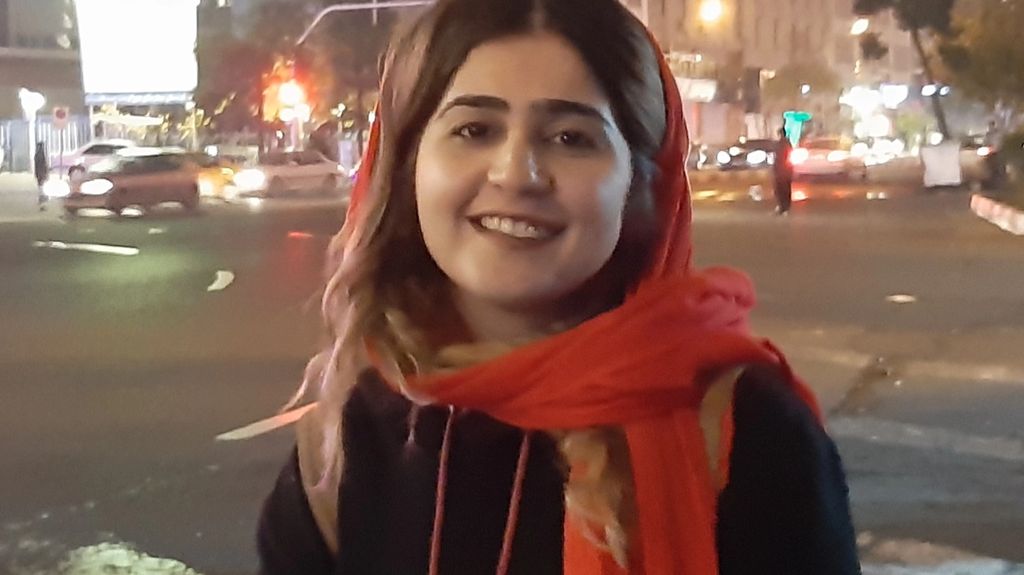
Activist Sepideh Gholain, who was re-arrested on Monday in Iran.

The brother of Iranian activist-cum-citizens’ journalist Sepideh Gholian reported Monday that his sister, on prison furlough, had been arrested at her home.

"A few minutes ago over thirty female and male agents attacked Sepideh Gholian's house, abducted her and took her to an unknown place, ”Mehdi Gholian wrote on Insatgram. “They also confiscated the mobile phones of all other family members."

An hour later Mehdi Gholian wrote in another social-media post that the Prisons Organization was responsible for the arrest.

In a series of tweets in September, Sepideh Gholian (Qolian), who was on parole from Bushehr prison, southern Iran, alleged abuse of female prisoners in the prison. She wrote that she had reported 20 cases to the authorities, including five described in her tweets, but had received no response.

"I knew I would face a godforsaken hell when I was banished to this prison last year," wrote Gholian, who had been sent to Bushehr prison in early March from Evin prison, Tehran. "But I couldn't even imagine the brutality reigning in this prison."

In March 2021, Gholian was taken "in handcuffs and chains," according to labor activist Esmail Bakhshi, from Evin to Bushehr, 1000km from Tehran. Bakhshi said Gholian had been told she was being taken to Ahvaz prison in her native Khuzestan province and only later realized she was in Bushehr, 430km from Ahvaz.

Gholian was sentenced to five years’ jail for 'disrupting public order' and‘assembly and collusion against national security' after arrest in 2018 following her role in publicizing labor protests in Khuzestan. Gholian’s memoir from time in Sepidar prison, Khuzestan, was published by Iran Wirein June 2020. She has gone on hunger strike several times.

Gholian made a confession that was aired by state television (IRIB) in January 2019. In the program she was described as an agent provocateur with ties to Marxist groups abroad who had encouraged a strike at the Haft Tappeh Agro-Industrial Complex in Khuzestan.

Gholian later alleged that Ameneh-Sadat Zabihpour, an IRIB journalist involved in filming the confession, had been involved as an interrogator and had tortured her to her to confess before the camera. Confessions, often full of claims of links to foreign conspiracies, have long played a significant role in Iranian political trials.

Most Viewed

US blockade enters murky phase as tankers spoof signals and buyers hesitate
1
ANALYSIS

US blockade enters murky phase as tankers spoof signals and buyers hesitate

2
INSIGHT

Ideology may be fading in Iran, but not in Kashmir's ‘Mini Iran'

3
INSIGHT

Hardliners push Hormuz ‘red line’ as US blockade tests Iran’s leverage

4
VOICES FROM IRAN

Hope and anger in Iran as fragile ceasefire persists

5

US sanctions oil network tied to Iranian tycoon Shamkhani

Banner
Banner

Spotlight

  • Hardliners push Hormuz ‘red line’ as US blockade tests Iran’s leverage
    INSIGHT

    Hardliners push Hormuz ‘red line’ as US blockade tests Iran’s leverage

  • Ideology may be fading in Iran, but not in Kashmir's ‘Mini Iran'
    INSIGHT

    Ideology may be fading in Iran, but not in Kashmir's ‘Mini Iran'

  • War damage amounts to $3,000 per Iranian, with blockade set to add to losses
    INSIGHT

    War damage amounts to $3,000 per Iranian, with blockade set to add to losses

  • Why the $100 billion Hormuz toll revenue is a myth
    ANALYSIS

    Why the $100 billion Hormuz toll revenue is a myth

  • US blockade targets Iran oil boom amid regional disruption
    ANALYSIS

    US blockade targets Iran oil boom amid regional disruption

  • Iran's digital economy battered by prolonged blackout
    INSIGHT

    Iran's digital economy battered by prolonged blackout

•
•
•

More Stories

Iran Starts Air Defense, Counter-Jamming Drills

Oct 12, 2021, 10:32 GMT+1

Iran’s air defenses conducted drills on Tuesday on countering electronic and cyber warfare, the Revolutionary Guard air defense headquarters announced.

Brigadier General Ghader Rahimzadeh, commander of the joint air defenses headquarters said that on the first day of drills dubbed Sky Defenders, units from Iran’s traditional army air defenses, IRGC Aerospace Force and the Air Force experimented with various tactics of countering electronic and cyber warfare.

Rahimzadeh said the drills aimed to evaluate the impact of possible electronic warfare of an adversary on Iran’s air defense radars. He added that the exercise was successful in identifying targets in an “environment of electronic warfare.” He added that locally manufactured electronic warfare equipment is being used in this exercise. In this stage jamming drones were used to test anti-aircraft interception systems and the stable operation of radars.

He added that “successful tests were conducted” on how to jam the adversary’s electronic warfare drones.

Iran’s radar systems, some based on domestic technology are not as advanced as need be in case of engagement with a technologically superior adversary.

Iran conducted major ground exercises last week on its northwestern borders near the Republic of Azerbaijan, after tensions flared up between the two counties.

Iran, Saudi Arabia Close To Reopening Consulates: Diplomatic Source

Oct 12, 2021, 09:21 GMT+1

Iran and Saudi Arabia are near agreement to restore diplomatic relations by reopening consulates, a diplomatic source has told AFP news agency on Monday.

The foreign diplomat who resides in Saudi Arabia said an agreement to ease tensions is imminent.

"They, in principle, have reached an agreement to reopen consulates... and I think an announcement of normalization of ties may come in the next few weeks," the diplomat told AFP on condition of anonymity.

The two Middle Eastern arch-rivals began talks in April with Iraqi mediation in Baghdad and have continued discussions since then. Iran has made optimistic statement in recent days, saying the talks “are on the right path”.

Iran’s foreign ministry said on Monday that Yemen, a major contentious issue between the two countries, is part of the talks.

The new government in Tehran headed by hardliner president Ebrahim Raisi has emphasized that Iran’s priority is improving relations with its neighbors. This could be related to Western pressure on Iran to change its regional policies and stop creating tension with meddling in Arab countries.

Saudi Arabia, which supported former US president Donald Trump’s decision to pull out of the 2015 nuclear agreement and impose ‘maximum pressure’ sanctions against Iran, wants Iran to stop supporting armed proxies in the region, including the Houthis in Yemen.

Microsoft Says Iranian Hackers Target US, Israeli Defense Firms

Oct 12, 2021, 08:25 GMT+1

Microsoft announced Monday that it has been tracking hacking activities by an Iran-linked group that targeted US and Israeli defense and other key companies.

The hackers were trying to guess passwords of users and accounts to penetrate defense technology companies and Persian Gulf ports of entry, as well as global maritime transportation companies with ties to the Middle East.

The group known as DEV-0343 was able to compromise just 20 passwords among hundreds it tried to penetrate, Microsoft said, adding, “DEV-0343 continues to evolve their techniques to refine its attacks. MSTIC noted that Office 365 accounts with multifactor authentication (MFA) enabled are resilient against password sprays.”

Iranian hackers have been highly active in the past decade and are believed to be as dangerous as Chinese and Russian groups that operate either within their respective intelligence services or are closely associated with them.

“Microsoft has directly notified customers that have been targeted or compromised, providing them with the information they need to secure their accounts,” the company said in a statement.

The focus of the hackers was defense technology companies working on military-grade radar development, drone technology, satellite systems and emergency response communication systems. “Further activity has targeted customers in geographic information systems (GIS), spatial analytics, regional ports of entry in the Persian Gulf, and several maritime and cargo transportation companies with a business focus in the Middle East,” Microsoft said.

As in the past cases of Iranian hacking aimed at military and sensitive economic targets this operation “likely supports the national interest of the Islamic Republic of Iran,” Microsoft said, and added, that its assessment shows “this targeting supports Iranian government tracking of adversary security services and maritime shipping in the Middle East to enhance their contingency plans.”

Microsoft did not attribute the hacking to any particular Iranian government entity, but the Islamic Revolution Guard Corps (IRGC) is known for its large ‘cyber army’ that engages in both suppression of internet access and cyber surveillance within Iran and disinformation activities abroad, as well as sophisticated hacking of Western and other targets.

Facebook also announced on Monday it has dismantled dozens of accounts engaged in dissemination of fake news within Iran. "We removed 93 Facebook accounts, 14 Pages, 15 Groups and 194 Instagram accounts in Iran that targeted primarily domestic audiences in that country, particularly in the Lorestan province," The social media company said.

CNN quoted Microsoft’s John Lambert as saying that his corporation discovered the hacking activity when responding to a breach of a US financial services company this summer. He added that Microsoft decided to release the information now to help organizations prepare for follow-on hacking attempts.

Hezbollah Wants US Sanctions Waiver To Import Iranian Fuel

Oct 11, 2021, 20:01 GMT+1

Lebanon's Hezbollah chief Hassan Nasrallah repeated calls Monday for the cabinet to seek a US sanctions waiver to import Iranian fuel amid crippling shortages.

Nasrallah said the total blackout that occurred on Saturday when Lebanon's two largest power plants ground to a halt was like a "clinical death" for the country.

The Iran-backed Lebanese Shi'ite Hezbollah group has been coordinating Iranian shipments of fuel oil and gasoline for Lebanon since August as shortages spread amid an economic meltdown, despite U.S. sanctions on Iranian oil sales.

However, so far it is not clear if Hezbollah delivered any fuel to the country’s power stations or how the fuel was used.

Lebanese Prime Minister Najib Mikati has said the Iranian shipments constitute a breach of his country's sovereignty.

Iran sends the fuel oil shipments organized by Hezbollah to the port of Baniyas in Syria and from there they are transported by truck to Lebanon.

Iran's Foreign Minister Hossein Amir-Abdollahian, on a visit to Beirut last week, said his country was ready to build two power plants in Lebanon, one in Beirut and the other in the south of the country, in a period of 18 months. The offer is more of a publicity stunt as Iran itself is gripped by power shortages unable to meet demand.

On Monday Nasrallah urged the cabinet to respond to his offer.

Iranian Officials Continue Talking Tough While Delaying Nuclear Talks

Oct 11, 2021, 17:03 GMT+1

The speaker of Iran’s parliament on Monday defending uranium enrichment demanded the lifting of US sanctions “as a first step” to revive the 2015 nuclear deal.

Mohammad Bagher Ghalibaf said the US should lift its ‘maximum pressure’ on Iran and referred to Tehran’s uranium enrichment effort as something mandated by legislation tied to the removal of US sanctions.

Meanwhile, in an interview on Iran's state television Sunday evening, Hossein Shariatmadari, the editor of Kayhan newspaper, which is close to Supreme Leader Ali Khamenei's office, likened the disputed 2015 nuclear deal with world powers to "a stinking dead body Iran should get rid of at once."

The statement by the influential editor who often echoes Khamenei's ideas may indicate that although the Supreme Leader has effectively consolidated his hardliner control by having Ebrahim Raisi, a like-minded protégé as president, more hardliner supporters are still showing defiance, a tool Tehran often uses to gain leverage.

Iran engaged in six rounds of talks with the West form April to June over reviving the Joint Comprehensive Plan of Action (JCPOA), until Tehran stopped attending. Shariatmadari reiterated that Iran will not gain anything by returning to the JCPOA.

Shariatmadari claimed that "This is no negotiation," citing Iran's security chief Ali Shamkhani as saying that that "the US side is suggesting lifting only some of the sanctions imposed by the Trump administration."

The remarks by Shariatmadari are made against a backdrop of statements by other Iranian officials. One of these statements was made by nuclear chief Mohammad Eslami who insisted that Iran is continuing 20 percent uranium enrichment and has stockpiled over 120 Kilograms of enriched uranium. Despite its defiant appearance, the statement may indicate that Iran is doing so only to have a bargaining chip during the talks.

Last week, moderate newspaper Et'tela'at in Tehran challenged a statement made by the Minister of Economy Ehsan Khandouzi who had said: "In order to control inflation we need to increase oil sales, find access to the country's frozen assets abroad and stop borrowing money from the Central Bank." The daily and several Iranians who commented on social media reminded the minister of the importance of negotiations with the United States and said that Khandouzi should explain how these goals can be attained while the sanctions are still in place."

A highly educated man, the Minister of Economy probably knew the answer, but he let the newspaper and social media users raise the point as it was not in his interest to say in a straightforward way that Iran needs to start negotiations urgently.

Foreign Minister Hossein Amir-Abdollahian's has repeatedly said that Iran is prepared to return to the talks soon. He has also said releasing Iran's assets in South Korea might help facilitate the resumption of the talks, giving a clue to the Americans about where to start.

Iranian commentator and foreign policy analyst Rahman Ghahremanpour observed in a tweet that Amir-Abdollahian “is in a difficult position. On the one hand, he needs to keep the people hopeful in the revival of the JCPOA, and on the other hand, he has to pretend that the situation has changed with the coming to power of the Raisi administration and Iran's positions have toughened. Striking a balance between the two is a very difficult task, particularly at the beginning of his career as foreign minister."