• العربية
  • فارسی
Brand
  • Iran Insight
  • Politics
  • Economy
  • Analysis
  • Special Report
  • Opinion
  • Podcast
  • Iran Insight
  • Politics
  • Economy
  • Analysis
  • Special Report
  • Opinion
  • Podcast
  • Theme
  • Language
    • العربية
    • فارسی
  • Iran Insight
  • Politics
  • Economy
  • Analysis
  • Special Report
  • Opinion
  • Podcast
All rights reserved for Volant Media UK Limited
volant media logo

Strong Ties With Russia, China Do Not Exclude Relations With West: Iran FM

Maryam Sinaiee
Maryam Sinaiee

Iran International

Oct 10, 2021, 15:01 GMT+1Updated: 17:36 GMT+1
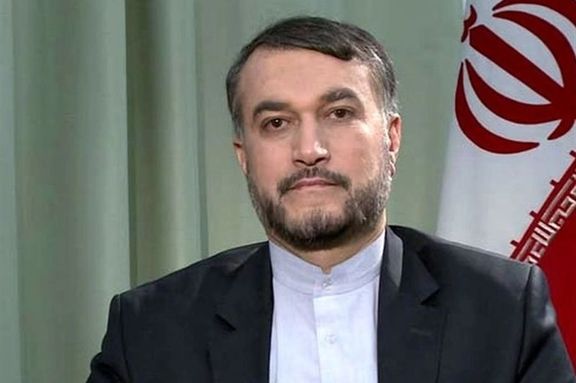
Hossein Amir-Abdollahian, Iran's foreign minister. FILE PHOTO

Iranian Foreign Minister Hossein Amir-Abdollahian said Sunday that relations with Asian countries should not mean ignoring relations with the West altogether.

Speaking to the Iranian Students News Agency (ISNA) after completion of his tour of Moscow, Beirut and Damascus, Amir-Abdollahian said "a balanced foreign policy" means following "active diplomacy with East and West" adding that Iran does not want to "tie the country to Russia and China" and would only follow its national interests.

As Iran has been holding talks in Vienna with the United States and its three European allies, the United Kingdom, France and Germany on reviving the 2015 nuclear agreement (JCPOA), its rhetoric of strengthening ties with China and Russia has intensified.

Amir-Abdollahian said Iran has made it clear to the European countries that following US policies and failing to honor their commitments against Iran will damage their own interests and keep them away from investment opportunities and trade with Iran. "We have told them that Iran's hand will not remain tied."

During his Moscow visit Amir Abdollahian said the government of President Ebrahim Raisi was ready to quickly expand ties with Russia. "This doesn’t mean that we’ll be dependent on China and Russia, but from a strategic point of view, we’ll use existing capacities to further the interests of both nations,” Amir Abdollahian said.

Before his confirmation by the parliament in August, Amir-Abdollahian said negotiating with the US was not a taboo and that he had three times engaged in direct talks with Americans in Baghdad.

Nevertheless, the Vienna talks to restore the JCPOA which he has pledged to continue until "all sanctions on Iran are lifted", have been in limbo since June. Iran has made repeated promises of returning to the negotiating table "soon" without setting a concrete date.

Pundits believe Iran is buying time to build more leverage before returning to the talks. On Sunday Iran's nuclear chief, Mohammad Eslami, announced that stockpiles of 20-percent enriched uranium have reached 120kg, a third more than previous estimates.

Tehran has ‘looked east’ in expanding cooperation with Russia and particularly with China to fill the vacuum left in its oil and gas projects by European companies and selling its crude oil. The new hardline president Ebrahim Raisi’s government has also invested much hope in its newly accepted full membership in the Shanghai Cooperation Organization (SCO) to boost its ailing economy.

The policy of relying on Asia or the East, particularly China and Russia, was promulgated by Supreme Leader Ali Khamenei in 2018, with the catchphrase, “Looking East”. Since then, his hardliner followers have made it one of the centerpieces of a ‘revolutionary economy’. In a speech on February 13, Khamenei reiterated that in resisting "US unilateralism," Iran should look to the east to achieve a "resistance economy" that could withstand US economic pressures.

President Ebrahim Raisi has stressed that his policy is to deepen ties with China and Russia.

His hardliner supporters, who accused the Rouhani government of giving importance only to relations with Western countries, claim China has been assisting Iran to dodge US sanctions and buying Iranian oil through back channels and not even declaring it in their customs reports.

However, close relations with China and Russia have not been the magic wand for Iran’s economy during three years of US sanctions. Overall trade is relatively small and there have been no notable investments to compensate for the absence of Western businesses.

Most Viewed

Iran International says it won’t be silenced after London arson attack
1

Iran International says it won’t be silenced after London arson attack

2
VOICES FROM IRAN

Hope and anger in Iran as fragile ceasefire persists

3

US sanctions oil network tied to Iranian tycoon Shamkhani

4

Iran halts petrochemical exports to supply domestic market

5
INSIGHT

How Tehran bends its own red lines to boost state rallies

Banner
Banner

Spotlight

  • Hardliners push Hormuz ‘red line’ as US blockade tests Iran’s leverage
    INSIGHT

    Hardliners push Hormuz ‘red line’ as US blockade tests Iran’s leverage

  • Ideology may be fading in Iran, but not in Kashmir's ‘Mini Iran'
    INSIGHT

    Ideology may be fading in Iran, but not in Kashmir's ‘Mini Iran'

  • War damage amounts to $3,000 per Iranian, with blockade set to add to losses
    INSIGHT

    War damage amounts to $3,000 per Iranian, with blockade set to add to losses

  • Why the $100 billion Hormuz toll revenue is a myth
    ANALYSIS

    Why the $100 billion Hormuz toll revenue is a myth

  • US blockade targets Iran oil boom amid regional disruption
    ANALYSIS

    US blockade targets Iran oil boom amid regional disruption

  • Iran's digital economy battered by prolonged blackout
    INSIGHT

    Iran's digital economy battered by prolonged blackout

•
•
•

More Stories

Iranian News Agency Harshly Attacks Iraqi Kurdish Leaders

Oct 10, 2021, 14:28 GMT+1

Fars news agency in Tehran affiliated with the Revolutionary Guard has harshly accused Iraqi Kurdish leaders of cooperating with foreign countries against Iran.

The tough-worded article says that Iraqi Kurdistan’s leadership has made northern Iraq a “backyard” for foreign intelligence services for creating insecurity in Iran and killing its nuclear scientists.

Iranian Kurdish separatist and opposition groups have bases in northern Iraq and Tehran often says they infiltrate into its territory for operations against government targets. The article by Fars accused the groups of assassinating a Kurdish shopkeeper a few days ago, who the insurgents thought supports the Islamic Republic.

Fars alleges that Kurdish leaders in northern Iraq “are fully aware” of operations and conspiracies against Iran and demands that the foreign ministry and the armed forces take actions against those responsible.

Iran last month used artillery and armed drones to attack targets in northern Iraq that it said were insurgent bases.

On October 7, Yahya Rahim-Safavi, the military adviser to Supreme Leader Ali Khamenei, warned Wednesday that Iran would not accept “any bordering country” hosting "anti-Iran terrorist groups."

Three Jailed Activists Say They Refuse To Sign Pledge Not To Sue Khamenei

Oct 10, 2021, 13:34 GMT+1

Three activists jailed since August 14 in Iran have said that they have refused to sign a pledge not to sue the country’s Supreme Leader in order to be freed.

Attorneys Mostafa Nili and Arash Kaykhosravi, along with activist Mehdi Mahmoudian had announced their intention in August to sue Supreme Leader Ali Khamenei for having banned the purchase of American and British Covid vaccines in January. They also accused top officials of gross mismanagement of the covid pandemic. Authorities immediately arrested them, and they have spent nearly two months in prison.

In a letter sent to an Islamic Republic civil rights watchdog, they said that authorities asked them to sign a pledge not to sue Khamenei, but they refused, and their detention continued.

With a fifth wave of the pandemic starting in July, tens of thousands of more Iranians have perished with public sentiment turning against Khamenei for having banned the importation of Western vaccines, setting back Iran’s vaccination program.

The three detainees also said they had intended to sue officials for diverting millions of dollars to organizations with no medical expertise that promised to produce home-grown vaccines.

Coming Weeks Are Decisive For Iran Nuclear Deal, Merkel Says

Oct 10, 2021, 10:55 GMT+1

The coming weeks are decisive for the future of the nuclear deal with Iran, German Chancellor Angela Merkel said on Sunday.

The German leader added that every day that passes without Tehran responding to US overtures will result in Iran enriching more uranium.

Speaking during a visit to Israel, the outgoing chancellor said that Russian President Vladimir Putin and Chinese President Xi Jinping also had a responsibility to help to push Iran back to the negotiating table, she said at a joint news conference with Israeli Prime Minister Naftali Bennett.

Western powers have been warning that time is running out to save the 2015 nuclear deal (JCPOA) but so far have taken no action.

"I also see a responsibility for Russia and China here, since if the JCPOA (nuclear deal) is no longer doing what it's meant to do then that's very difficult, so we are now in very decisive weeks for this deal."

Iran in June suspended nuclear negotiations that had started in Vienna in April, saying its new government needed time to prepare for further talks, but so far has delayed a decision.

Iran's nuclear chief Mohammad Salami told state television on Saturday that Tehran has stockpiled 120 kg of 20-percent enriched uranium.

With reporting by Reuters

Lebanon Plunges Into Darkness Despite Iranian Fuel To Hezbollah

Oct 10, 2021, 10:39 GMT+1

Lebanon's two main power plants were forced to shut down after running out of fuel plunging the country into darkness on Saturday, despite Iran sending fuel.

Iran began sending fuel to Hezbollah, its ally in Lebanon in September. The Shiite militia group said its arrangement with Iran would help the country amid a crippling energy crisis, but it is not clear why the shipments have not reached the power plants.

So far two vessels have docked at Syrian ports from where the fuel is being sent to Hezbollah by tanker trucks. Hundreds of these tankers are said to have delivered fuel.

Erratic power supplies have put hospitals and essential services in crisis mode.

The Lebanese increasingly depend on private operators that also struggle to secure supplies amid an unprecedented crash of the national currency.

The shortage of diesel and fuel, along with an antiquated infrastructure, has worsened power cuts that have been a fixture for years.

Blackouts that used to last for three to six hours could now leave entire areas with no more than two hours of state power a day.

On Saturday, the state electricity company said Zahrani power plant in the country's south was forced to shut down because of fuel shortage; the main plant in the north was shut down on Thursday.

Electricite Du Liban said the shutdown reduces the total power supply to below 270 megawatts, which means a major drop in the stability of the grid.

It said it would reach out to fuel facilities in the country's north and south to see if they can procure enough fuel to bring back power.

It added that a new shipment of fuel from Iraq is expected next week.

But the company, responsible for most of the government's debts, is dependent on credit from the country's central bank, which is struggling with dwindling reserves.

The government has gradually raised prices of fuel and diesel as the central bank cut back on subsidizing dollars for imports, adding to the hardships in Lebanon, where about three quarters of the population has plunged into poverty over the last year.

With prices soaring and unemployment at a record high, many families have given up private generators and few hours of state power a day is all they get.

On Saturday, distributors of gas canisters used for cooking and heating stopped operating, saying subsidy cuts amid black-market currency fluctuations meant they were selling at a loss.

The energy sector has been a huge drain on state coffers for decades.

The electricity company has annual losses of up to $1.5 billion and has cost the state more than $40 billion over the past decades.

Energy sector reforms have been a key demand by the World Bank and the International Monetary Fund.

Iran’s foreign minister Hossein Amir-Abdollahian who visited Lebanon October 7-8 promised more fuel deliveries while the government has no control over fuel already sent to Hezbollah.

Iraq has also made a swap deal with the government that has helped Lebanon's state electricity company stay operational for days.

The new Lebanese government is also negotiating supplies of electricity from Jordan and natural gas from Egypt, also through Syria.

But those deals are likely to take months.

With reporting by AP

Liquidity, State Debt To Banks In Iran Grew Eightfold Since 2013

Oct 10, 2021, 08:16 GMT+1
•
Dalga Khatinoglu

A report by Iran’s Central Bank (CBI) issued in August and made available in October shows an extraordinary growth in liquidity, which fuels high inflation.

The Central Bank has said that liquidity has increased close to 40,000 trillion rials, or $160 billion based on the open market USD rate, (1 USD=250,000 rials), in August 2021, when ex-president Hassan Rouhani left office.

Liquidy increased by 39% year-on-year, but grew eightfold since August 2013, when Rouhani took office.

Liquidity is the major factor in pushing the inflation rate up, which stood at 45.8% last month in Iran.

According to the International Monetary Fund, inflation in Iran was the highest in the world after Venezuela, Sudan, Surinam and Lebanon during last year and it is expected to get even worse in the current year.

United States sanctions on Iran’s oil exports and the banking sector have dramatically reduced government revenues since 2018, forcing CBI to print money. Iran’s economy had barely begun to recover from international nuclear sanctions (2011-2016), when former US president Donald Trump withdrew from the 2015 nuclear deal and reimposed tough sanctions in May 2018.

Iran’s oil exports plunged from a high of around 2.5 million barrels per day in 2017 to as low as 320,000 bpd in 2019-2020, according Kpler data intelligence firm. Illicit oil exports have somewhat increased in 2021 but by their nature of secret deals, there is little cash revenue for Iran.

According to CBI, Iran’s total revenues from crude oil, condensate, petroleum products and gas exports stood at $21 billion during the last year, compared to above $60 billion during pre-sanctions era.

The Central Bank of Iran’s statistics also show that government debt to domestic banks has increased by 35% in August year-on-year and reached 6,550 trillion rials, or $26.2 billion, of which one third is the debt to the Central Bank, indicating a 50% growth year-on-year.

Government debts to the domestic banks increased by 750% during Hassan Rouhani’s presidency.

The Iranian government hasn’t published the total figure for state debts to all sectors, but according to the International Monetary Fund’s estimate, its net debts stood at $227 billion last year. It has more than doubled since 2018.

This amount is also 5 times larger than the current government budget, based on the open market dollar rate, and 36 times more based on the official dollar rate rate.

Each US dollar buys around 280,000 rials in open markets in October, while the official exchange rate is 42,000 rials.

It is not clear how the government could pay off such a huge amount, when the Parliament Research Center has estimated that current year’s budget faces more than 30% deficit for the third consecutive year.

The Central Bank of Iran has also put the government’s foreign debts at $8.84 billion as of August 2021, slightly less than the same month in 2020.