• العربية
  • فارسی
Brand
  • Iran Insight
  • Politics
  • Economy
  • Analysis
  • Special Report
  • Opinion
  • Podcast
  • Iran Insight
  • Politics
  • Economy
  • Analysis
  • Special Report
  • Opinion
  • Podcast
  • Theme
  • Language
    • العربية
    • فارسی
  • Iran Insight
  • Politics
  • Economy
  • Analysis
  • Special Report
  • Opinion
  • Podcast
All rights reserved for Volant Media UK Limited
volant media logo

Iran Hardliners Accuse Former Presidents Of Turning Into Opposition Figures
Oct 6, 2021, 08:08 GMT+1Updated: 16:00 GMT+0
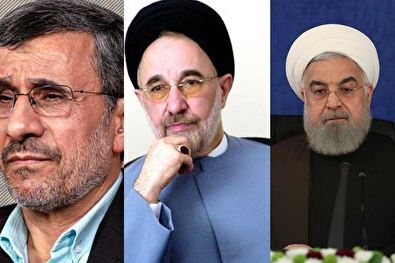
Iran's three former president. L-R, Ahmadinejad, Khatami and Rouhani.

A prominent right-wing commentator in Iran has called the country's former presidents opposition figures and said that the regime should “twist their arms.”

Hassan Rahimpour Azghadi, an ultraconservative commentator who usually speaks on Iranian national television as a member of the Cultural Revolution Council, said in an interview with the right-wing Students News Network (SNN) that criticisms by former presidents of Iran are "non-constructive" and aimed at "toppling other political figures and replacing them."

Among former presidents only populist Mahmoud Ahmadinejad (2005-2013) has been vocal since 2017 when his candidacy for president was rejected by the Guardian Council, controlled by Supreme Leader Ali Khamenei. His successor Hassan Rouhani has disappeared from the scene after his term ended in early August, and Mohammad Khatami (1997-2005) has been forced into silence by the intelligence services. Even Khatami’s photos are banned from government-controlled media.

Hardliners loyal to Supreme Leader Ali Khamenei have been occasionally attacking former presidents for not being fully in synch with prevailing policies. They have been even running a campaign to prosecute Rouhani.

Aghzadi even named the deceased former deputy supreme leader Ayatollah Hossein Ali Montazeri and the Islamic Republic's first Prime Minister Mehdi Bazargan as opposition figures. What all these politicians had in common was open or indirect disagreement with the overarching power of the Supreme Leader in the Islamic Republic.

Azghadi further criticized the former presidents for questioning the validity of the Islamic Republic's Constitution once they left office. However, he failed to mention that Mohammad Khatami and Hassan Rouhani had spoken out even when they were in office.

Azghadi stressed that those former officials need to understand that what they criticize now is the outcome of their own political performance. Meanwhile he claimed that former officials should not act against the system as this is a political system that can be reformed through democratic means.

He made the statement mindless of the fact that the existence of the non-elected Guardian Council that handpicks election candidates based on their loyalty to the Supreme Leader is far from being democratic.

A commentary published by Iran's leading economic daily Donyaye Eqtesad tried to respond to hardliner rhetoric by observing that former presidents have always been complaining about the intervention of non-elected and institutions without executive responsibility in the affairs of their administration.

The daily pointed out that if former presidents sound like opposition figures, then tens of millions of voters who had voted for them in various rounds of elections are now part of the opposition.

Donyaye Eqtesad also pointed to the limitations imposed on Mohammad Khatami, saying that “his arm has already been twisted.” The daily also reminded that that two months after Hassan Rouhani left office, he was mentioned only once in the media with no derogatory comment when he sent a condolence message following the death of a top cleric.

The daily wrote that if anyone's arm is to be twisted, it is the arm of those, including Azghadi, who have been on the Cultural Revolution Council and have degraded Iranian universities to the level of high schools.

The commentary asked at the end whether Vice President for Economic Affairs Mohsen Rezaei, a former commander of the IRGC and a candidate in the presidential election, is also an opposition figure, because he said during televised debates that hardliners "have kicked so many revolutionary figures out of the train of the revolution that what has remained of the revolution is a scooter!"

The daily also asked referring to Azghadi’s opposition against all presidents since 1990: "If being an opposition figure is bad, why Azghadi himself has been an opposition figure for such a long time?"


Most Viewed

Ghalibaf defends Iran-US talks amid hardline backlash
1
INSIGHT

Ghalibaf defends Iran-US talks amid hardline backlash

2
INSIGHT

100 days after carnage: Iran economy reels from war, inflation, unemployment

3
INSIGHT

A nation in limbo: 100 days after the massacre, has the world moved on?

4
ANALYSIS

From instability to influence: Pakistan’s pivotal role in US-Iran diplomacy

5
ANALYSIS

100 days on: why Iran’s January protests spread across social classes

Banner
Banner

Spotlight

  • War-hit homeowners feel abandoned as Iran’s reconstruction aid fades

    War-hit homeowners feel abandoned as Iran’s reconstruction aid fades

  • 100 days on: the anatomy of Iran’s January crackdown
    INSIGHT

    100 days on: the anatomy of Iran’s January crackdown

  • Ghalibaf defends Iran-US talks amid hardline backlash
    INSIGHT

    Ghalibaf defends Iran-US talks amid hardline backlash

  • 100 days on: why Iran’s January protests spread across social classes
    ANALYSIS

    100 days on: why Iran’s January protests spread across social classes

  • From instability to influence: Pakistan’s pivotal role in US-Iran diplomacy
    ANALYSIS

    From instability to influence: Pakistan’s pivotal role in US-Iran diplomacy

  • A nation in limbo: 100 days after the massacre, has the world moved on?
    INSIGHT

    A nation in limbo: 100 days after the massacre, has the world moved on?

•
•
•

More Stories

Iran FM Heads For Moscow As Tehran Bars Azerbaijan Military Overflights

Oct 5, 2021, 19:40 GMT+1
•
Maryam Sinaiee

Tension between Iran and Azerbaijan heightened Tuesday as Baku shut down an Iranian mosque and Tehran barred Azerbaijani military flights over its territory.

Facing his first crisis in office, Hossein Amir-Abdollahian, Iran’s foreign minister who met his Armenian counterpart Ararat Mirzoyan in Tehran Monday, arrived in Moscow Tuesday. A joint news conference with Sergei Lavrov, Russia’s veteran foreign minister, is scheduled for Wednesday morning.

Kazem Jalali, Iran's ambassador to Moscow, said Wednesday that the meeting had gained importance with developments in the Caucasus and in Afghanistan. Azerbaijan, Turkey and Pakistan continued trilateral military drills dubbed “Indestructible Brotherhood 2021" in the NAR Tuesday near the Iran border.

Moscow brokered an uneasy agreement ending last year’s six-week war between Azerbaijan and Armenia, when the Azeris reclaimed the disputed enclave of Nagorno-Karabakh. The situation has since simmered, with occasional violence, and have centered of late on a stretch of road linking Iran and Armeniaoccupied by Azerbaijani troops.

Several Azerbaijani news agencies reported that Iran on Tuesday informed Azerbaijan that it had closed Iranian airspace to Azerbaijani aircraft carrying military supplies to the Azeri enclave ‘Nakhchivan Autonomous Republic,’ bordered by Armenia and by Iran to its south.

The move angered Baku, which called it an act dictated by Armenia. The defense ministry issued a statement calling the decision a betrayalthat led it to draw “unambiguous conclusions” about Iranian foreign policy.

The statement denied Iran’s move would “cause substantial harm to Azerbaijan.” Without access to Iranian airspace, Baku would need to supply the NAR by a roundabout route through Georgia and Turkey.

The Iranian Embassy in Baku in a statement Tuesday said Azerbaijani police inspected the Iranian mosque known as Iranian Husseiniya in Baku and shut it down.

Ehsan Zahidov,spokesman for the Azeri interior ministry, told the Qafqazinfo news-site that Covid infection had risen in recent days in several places in Baku, including the mosque. Zahidov said other places have been shut down for the same reason to allow preventative action.

The mosque is affiliated to the Iranian embassy and houses the office of Ali-Akbar Ojaghnejad, representative in Azerbaijan of Iranian leader Ali Khamenei. Ojaghnejad holds daily prayers at the mosque. The Iranian envoy, Seyed-Abbas Mousavi, later said that the closure had not affected Ojaghnejad’s work, which is conducted in the same building.

The Iranian embassy in Baku was attacked by Azerbaijani protesters last Thursday evening. Mousavi said Friday he had strongly protested over "disrespect and aggression” and that four perpetrators had been detained.

Iran Had Negative Investment Rate For The Past Ten Years

Oct 5, 2021, 19:19 GMT+1

The Tehran chamber of commerce in a report has said that investments in the Iranian economy have steadily declined in the past decade, reaching negative growth.

The worst declines have been from March 2019 to March 2021, as US sanctions reduced the government’s ability to invest, and the private sector was weakened by a declining economy.

In the past Iranian year ending on March 20, investments totaled $4 billion that was less than capital depreciation, leading to a 4.8 percent negative rate of investments.

As assets, such as machinery and buildings, break down or fall into disrepair capital is needed to rejuvenate infrastructure. If new investments are less than what is needed for upkeep, the result is a negative rate of investments.

In the past decade in Iran investments in machinery declined by 7.3 percent and in buildings 4 percent.

The chamber of commerce calculated that if US sanctions are lifted now, Iran would need 13 years from to return to the rate of investments it had in 2011, if it can muster a 5 percent annual economic growth rate.

Quest For More Leverage Drives Iran's Nuclear Stalling Tactic, Analysts Say

Oct 5, 2021, 14:00 GMT+1

Western powers have been trying for weeks to get Tehran's answer to one question - when will it return to nuclear talks that have been on hold since June.

Iran's response has been a simple "soon", even at one point saying that 'soon' has a different connotation in Iran.

Behind Tehran's stalling is an attempt to gain leverage to extract more concessions when negotiations do eventually resume, officials and analysts said, including by advancing its uranium enrichment program, a possible pathway to a nuclear bomb.

Iran has long denied seeking to weaponize nuclear energy.

The talks, which aim to bring both Washington and Tehran back into compliance with a 2015 nuclear pact aimed at curbing the Iranian enrichment program, were adjourned in June after hardliner cleric Ebrahim Raisi was elected Iran's president.

"Iran will eventually return to the talks in Vienna. But we are in no rush to do so because time is on our side. Our nuclear advances further every day," a senior Iranian official said on condition of anonymity.

Ali Vaez, senior Iran analyst at the International Crisis Group, said "more time equals more leverage, given the exponential growth of Iran’s nuclear program".

While China and Russia, closer trading partners of Iran, are more restrained, Western parties to the pact can scarcely conceal their frustration. The United States and European powers have urged Iran to resume talks, saying the diplomatic window would not stay open forever as Tehran's nuclear program is advancing well beyond the limits set by the 2015 pact.

The nuclear agreement limited Iran’s uranium enrichment activity to make it harder for Tehran to develop nuclear arms, in return for lifting international sanctions.

But former U.S. President Donald Trump ditched the deal in 2018, saying it did not do enough to curb Iran’s nuclear activities, ballistic missile program and regional influence, and reimposed sanctions that have crippled Iran’s economy.

In response, Tehran breached the deal by rebuilding stockpiles of enriched uranium, refining it to higher fissile purity and installing advanced centrifuges to speed up output.

"They (Iran) keep saying they are going to come back to the table. But when they say soon ... it means absolutely nothing," said a senior European diplomat.

"That doesn't mean we think they don't want to come back, but we think they want their cake and to eat it. They want to create a fait accompli on the ground - technical and nuclear - and preserve the possibility of a negotiation."

MORE FOR LESS

Emboldened by the chaotic U.S. withdrawal from Afghanistan, Iran's rulers are confident their stalling strategy will not bring serious repercussions, analysts said, especially when U.S. President Joe Biden is embroiled in a growing rivalry with China and battling a COVID-19 crisis at home.

In contrast, the Biden administration is signaling that Iran should take nothing for granted.

Top US officials will tell visiting Israeli counterparts in Washington on Tuesday they are committed to diplomacy but would be prepared to pursue "other avenues" to ensure Tehran does not acquire a nuclear weapon, a senior U.S. official said.

Israel says it will not allow Tehran to get a nuclear bomb.

The man with ultimate authority in Iran, Supreme Leader Ayatollah Ali Khamenei, has blamed the United States for the pause in the talks.

"Ayatollah Khamenei seems to believe that by waiting, he can get a better deal from Washington. That time is on his side," said Meir Javedanfar, Iran lecturer at Israel's Reichman University.

Tehran and Washington still disagree on which steps need to be taken and when, with the key issues being what nuclear limits Tehran will accept and what sanctions Washington will remove.

The fact that indirect talks between Tehran and Washington paused after the election of Raisi was a sign of Tehran's plan "to press for major concessions" from the United States, said a former Iranian official.

"The establishment is also weighing different tactics to get more and give less in return. It takes time to determine their strategy," he said.

Naming Ali Bagheri Kani, an ardent critic of the 2015 pact, to replace former pragmatist chief nuclear negotiator Abbas Araghchi, signals Tehran will take an uncompromising approach when the talks resume, Eurasia Group analyst Henry Rome said.

ECONOMIC RISK

In addition to seeking the lifting of Trump-era sanctions in a verifiable process, Tehran also wants Washington to remove Iran's Revolutionary Guards from a terrorism blacklist. It also wants Europe to guarantee foreign investors will return, and assurances that Washington will not renege on the deal again.

For his part, Biden wants to restore the pact's nuclear limits and, if possible, extend them while pushing back against what he has called Iran's other destabilizing activities.

Sanam Vakil, deputy director of Chatham House’s Middle East and North Africa Program, said Iran would 'win' if it gained further concessions from Washington, but should the deal collapse Iran's rulers sense that they could survive through "maximum resistance", a reference to economic self-reliance.

However, Iran's foot-dragging strategy could weaken the country's clerical rulers by further hurting an economy already grappling with squeezed oil revenues.

The authorities fear a re-eruption of unrest among its core supporters lower-income Iranians - whose periodic bouts of protest in recent years reminded them how vulnerable they could be to popular anger over economic hardships.

"A failure to revive the nuclear deal entails real economic risk for Iran ... but politics trumps economics right now," Rome said.

Analysis by Parisa Hafezi and John Irish, Reuters

Iran, Armenia Determined To Complete Transit Road To Bypass Azerbaijan

Oct 5, 2021, 13:49 GMT+1
•
Maryam Sinaiee

Iran is ready to help Armenia complete its North-South Road so both can avoid a road controlled by Azerbaijan since last year’s Armenia-Azerbaijan war.

Press TV, Iran’s English-language broadcaster, and Armenian news agencies reported that Deputy Transportation Minister Kheirollah Khademi arrived in Armenia Monday to express Tehran’s financial and technical support for a project allowing cargoes from Iran and elsewhere to bypass Azerbaijan-run territory on their way to Russia and Europe.

Khademi is visiting construction sites for Armenia's Tatev project, a 400-kilometer transit road linking the Iranian border crossing at Nordooz to the Armenian capital Yerevan.

Map showing road from Iran to Armenia and north.
100%
Map showing road from Iran to Armenia and north.

Over half a 43km road, from Tatev to Aghvani, bypassing the Goris-Kapan stretch that is in the Armenian region of Syunik but since last year’s war under Azeri control, has been built. But it is barely suitable for large trucks and trailers. Armenia is planning a third bypass road, from Tatev to Ltsen.

In his joint press conference in Tehran Monday, Armenia's Foreign Minister Ararat Mirzoyan said he had briefed his Iranian counterpart Hossein Amir-Abdollahian on the new roads. The Iranian foreign minister said that joint plans for direct transit would be "finalized and implemented" very soon.

As things stand, Iranian trucks face a $130 levy imposed by the Azeris, who have been stopping Iranian trucks using the Goris-Kapan road.

Armenian economist Suren Parsyan Monday told the United Kingdom-funded JAMnews that Armenia’s annual trade turnover with Iran was $410 million, made up of $90 million of electricity exported to Iran and $320 million in imports of gas, oil products, fertilizers, and construction materials.

Armenia exports to Arab and Asian countries through Iran. For Iran, Armenia offers access to markets in Georgia, Russia, the Black Sea states, and European countries.

According to Parsyan, the Tatev-Aghvani road cannot support the same volume of cargo even if widened. Parsyan also told JAMnews that the budget constraints meant construction would be delayed until at the end of 2022 and might take three years.

Regional tensions, which have simmered since last year’s Armenia-Azerbaijan six-week conflict, escalated August 25 when Azerbaijani troops denied Armenian vehicles access to part of the 21km Goris-Kapan road. The arrest of two Iranian truck drivers for "illegal entry into Azerbaijani territory" caused alarm in Tehran.

Iran Expecting Serious Energy Shortage In Winter

Oct 5, 2021, 10:58 GMT+1

Iran is ready to solve the global energy crisis if the West lifts crude oil export sanctions, oil minister Javad Owji claimed on Monday, amid domestic shortage.

Owji’s claim came as Iran is bracing for a serious natural gas shortage this winter that will certainly lead to major energy shortage and also power cuts impacting both residential and industrial customers, similar to electricity shortages last winter.

Top officials in both the capital Tehran and the central city of Esfahan have warned of gas shortages in the fall and winter.

In absence of foreign investments of money and technology in Iran oil and natural gas sectors, production in South Pars gas fields in the Persian Gulf have not kept up with rising domestic demand and exports to Iraq.

Consumer demand for electricity has particularly increased because Iran offers the cheapest rates in the world. Consumers have little incentive to save energy, with electricity demand rising to 60,000 megawatts in summer and winter peak seasons.

Just in Esfahan, the general manager of the local gas company warned that daily shortages this winter will reach 25-million cubic meters of gas. Owji had warned in September that the country would face a 200-million cubic meter shortage this winter.

Reports in local media have said that fuel reserves at power stations is 30 percent less than required for winter months. Part of the problem is lack of tanker trucks to feed the power plants as many have become too old to operate. This is an indication of lack of investments as the country has been under UN or US sanctions during most of the past decade.

Thenatural gas shortage also has an environmental consequence, when Iranian power plants resort to burning mazut, a dirty oil biproduct. Last winter, smug and pollution covered all major Iranian cities as mazut was used to compensate for the gas shortage.

Iran is the Middle East’s largest electricity generator and the 14th largest globally. Ashley-Edison, A UK electricity leader estimates 80 percent of Iran’s output is from from fossil-fuel plants, 16 percent from hydroelectric plants, and 1.3 percent from Iran’s sole nuclear power plant at Bushehr. Tehran is in talks with Russia and South Korea over building eight atomic reactors.





