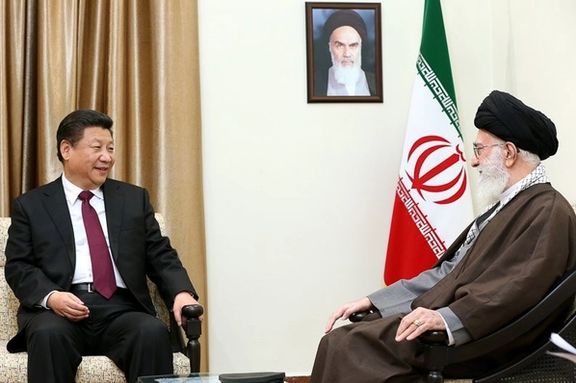
China's President Xi Jinping meeting with Iran's Supreme Leader Ali Khamenei in 2016.
Fars news agency, an affiliate of Iran’s Revolutionary Guards, has run a series of articles exploring China’s help in combating United States oil sanctions.
Under the rubric ‘Eastern Puzzle,’ Fars has argued that US sanctions are part of a wider scheme to restrict China's access to crude from the Persian Gulf − and that China in response is ready to help Iran to improve its own energy security.
"Given the successful experience of Iran's cooperation with China during the ninth and tenth administrations [of President Mahmoud Ahmadinejad, 2005-13] in circumventing US sanctions, it appears that after eight years of coldness in the relations between the two countries, signing strategic and key energy, transit and investment contracts and agreements will soon be on the agenda again," Fars said in one article, published September 29.
The "eight years of coldness in relations" according to Fars marked the two terms of Hassan Rouhani's presidency when hardliners in Iran campaigned against him for being pro-West, while former US president Donald Trump walked away from the 2015 nuclear deal and imposed heavy sanctions on Iran.
President Ebrahim Raisi has stressed that his policy is to deepen ties with China and Russia. "The 13th administration has from first day put two things at the top of its agenda, one is giving priority to reinforcing relations with eastern countries, China and Russia in particular, and the second is adopting a strong position regarding the nuclear case," Fars wrote Monday.
Withstanding pressure
Supreme Leader Ali Khamenei has also for a few years taken up the catchphrase “Looking East.” In a speech February 13, 2021, he said that in resisting "US unilateralism," Iran should look to the east to achieve a "resistance economy" that could withstand US economic pressures.
Fars supported its argument that US sanctions were aimed in part to "harness China" with economist Majid Shakeri saying in one article in the series that "those who follow the issue…closely have admitted that since 2019 the US sanctions have been targeting not Iran's oil exports, but China's oil imports from Iran."
While imports from Iran are a small part of Bejing’s 9.7 million barrels a day (bpd) of crude imports − even before US ‘maximum pressure’ sanctions China imported only around 1 million bpd from Iran − Beijing takes the view that the trade is perfectly legal and recently condemned the US’s “long arm jurisdiction.”
Fars noted that payment methods involved bartering oil with commodities or investment, international money exchangers, using small banks in China that the US cannot easily monitor, and payment in the Chinese yuan.
Fars suggested that with the help of Chinese customs Iran's oil exports now exceeded 1 million bpd. "If the Iranian government adopts a correct strategy in its dealings with China, the Chinese can offer considerable assistance to Iran in circumventing sanctions and selling its oil," the agency noted on September 29.
Iran's Supreme Leader Ali Khamenei with commanders of IRGC in 2019
The Office of Israel’s Prime Minister Naftali Bennett on Monday announced the thwarting of an Iranian terror plot targeting Israeli businessmen in Cyprus.
Such operations come as no surprise, as similar incidents were uncovered in recent years. But the Cyprus ploy is notable for three reasons: Tehran’s Axis of Resistance’s history of using Cyprus as a launchpad; the Iranian focus on targeting Israeli businessmen worldwide; and the nationality of the suspect in question.
Cyprus has often served as a platform for Iran’s Axis of Resistance to target Israel in the past. In 2012, Israel accused Tehran and the Party of God of complicity in a plot to target Israelis in Cyprus. Fast forward to 2015, when Cyprus imprisoned a Hezbollah operative after he was arrested in May of that year in possession of 8.2 tons of ammonium nitrate fertilizer, which was in a house in Larnaca.
Indeed, the timing of the operation is also important to consider. It follows a report over the summer by El Tiempo, a leading Colombian newspaper, about how Colombian intelligence uncovered a complex Iranian terror plot which also targeted Israeli businessmen in the country. The plot was allegedly masterminded by a Quds Force operative Rahmat Asadi, who reportedly criminally outsourced the gambit. Israeli media also reported on Monday about an attempt by Iran to target the car of an Israeli diplomat in Baku, Azerbaijan’s capital. This followed reports in February of Iranian operatives casing US, Israeli, and Emirati embassies in East Africa for potential attacks and another episode in India in January, which featured a low-intensity explosion near the Israeli embassy in New Delhi.
The uptick in these plots is reminiscent of the state of play in 2012, when multiple attempted or actualized attacks took place in Azerbaijan, Bulgaria, Cyprus, Georgia, India, Kenya, and Thailand, targeting Israeli interests. It’s not only the pace, but also the places which are evocative of the events from 2012. Azerbaijan, Cyprus, India, and Africa all appear to be choice locales for the Axis of Resistance, given perceived freedom of movement or permissive environments for such illicit activity. Tellingly, Israel issued a travel warning for some of these same places back in December.
Additionally, back in 2012, Israel’s reported assassinations of Iranian nuclear scientists coupled with the killing of senior Hezbollah commander Imad Mughniyeh provided the backdrop. Almost ten years later, in 2021, the assassinations of former Quds Force Commander Qassem Soleimani and the late Deputy Defense Minister and the father of Iran’s past nuclear weapons program Mohsen Fakhrizadeh likely fuel Iranian motivation for these daring schemes. This is not to mention the repeated sabotage operations against Iranian nuclear facilities over the past year.
Lastly, the suspects in all three cases in Cyprus were non-Iranian foreign nationals. In 2012, it was a Swedish passport holder of Lebanese descent. In 2015, Hussein Bassam Abdallah, with Canadian and Lebanese nationality, was arrested. In the current case, initial reports indicate the suspect is Azeri with a Russian passport. Such a modus operandi enables freedom of movement as well as masks Iranian fingerprints. The Azeri nationality of the suspect also raises questions given the ongoing tension between Azerbaijan and Iran, in part, over Baku’s relations with Israel, as well as whether Iran outsourced the hit to a criminal syndicate, as it did in Colombia.
In the end, Tehran appears to be resorting to a familiar playbook of undertaking multiple plots in countries that are vulnerable to infiltration in the context of repeated Israeli operations targeting its nuclear program. 2021 is looking very much like 2012.
Baqer Namazi and his son Siamak in photo before their ordeal in Iran.
Lawyers for an 84-year-old Iranian American, who was formerly imprisoned by Iran and whose son remains jailed there, urged Tehran on Monday to let him leave the country for medical care, saying he needs immediate surgery for an arterial blockage.
Baquer Namazi was convicted of "collaboration with a hostile government" in 2016 and sentenced to 10 years in prison. Iranian authorities released him on medical grounds in 2018 and closed his case last year, commuting his sentence to time served.
However, his son, Siamak Namazi, 49, remains in prison in Iran after being convicted of the same charge. The U.S. government has described the charges against both as baseless.
Iranian Americans, whose U.S. citizenship is not recognized by Tehran, are often pawns between the two nations, now at odds over whether to revive a fraying 2015 pact under which Iran limited its nuclear program in return for sanctions relief.
In a letter to the U.N. Special Rapporteur on the Right to Health, a lawyer for the family, Jared Genser, said the elder Namazi needed immediate surgery for a 95%-97% blockage in one of his internal carotid arteries, which supply blood to the brain.
It cited one physician as saying he required surgery within seven to 10 days and it argued this must be performed outside Iran both because recovery requires a stress-free environment and because Iranian hospitals are struggling with COVID-19.
The Iranian mission to the United Nations did not immediately respond to a request for comment.
Genser said Namazi has been under an effective international travel ban since his case was closed, arguing that this, as well as his prior treatment by Iranian authorities, constitutes a violation of his "right to health" under the International Covenant on Economic, Social and Cultural Rights.
Genser asked the special rapporteur to investigate and to urge Iran to let Baquer Namazi travel abroad for treatment. He also told a virtual news conference he wanted U.S. President Joe Biden to "personally engage" to allow Namazi to travel.
"My dad is dying," another son, Babak Namazi, told Reuters by phone from Dubai.
"My father has already lost so much precious time," he told the virtual news conference, at times crying. "I am begging Iran to let him spend whatever small amount of time he has left with his family, my brother Siamak included."
Saeed Khatibzadeh, Spokesman of Iran's foreign ministry. FILE PHOTO
Insisting there was “no substitute” for Iran’s 2015 nuclear deal, the foreign ministry spokesman Monday dismissed any urgency in restarting talks to revive it.
Saeed Khatibzadeh pointed out that United States president Joe Biden had been in office for three months before talks began in Vienna on renewing the agreement, the JCPOA (Joint Comprehensive Plan of Action).
With new Iranian president Ebrahim Raisi (Raeesi) in office “for less than 55 days,” said the spokesman, “a new negotiation team may have their own views” while other parties to the Vienna talks were realizing they needed to be more flexible.
Studying the issue
The new team, the spokesman said, were studying “all the issues” in the six past rounds of Vienna talks, which formally involve remaining JCPOA signatories − China, France, Germany, Iran, Russia and the United Kingdom − as well as indirectly the United States, which under former US president Donald Trump left the deal in 2018 and imposed stringent sanctions on Tehran that remain in place.
The European signatories, while calling on both the US and Iran to abide by the JCPOA, have become increasingly uneasy at the expertise Iran is gaining with steps taken since 2019 expanding the nuclear program beyond JCPOA limits. The Europeans also sense that the Raisi administration may believe it is in stronger position with some signs of recovery in the Iranian economy.
The German foreign ministry Monday issued a statement that Iran could not “set further conditions for resuming the talks,” which should “resume as soon a possible.” Berlin’s statement followed a suggestion from Iran’s foreign minister Hossein Amir-Abdollahian Saturday, that while in New York last month for the United Nations general assembly he told US officials through intermediaries that he would accept their request for a meeting if Washington as a good-will gesture released $10 billion of Iran’s assets frozen abroad.
Asked about this Monday, Khatibzadeh said the US should release funds “to show they mean what they say.” The spokesman referred to reports that the US wanted the Vienna talks to include Iran’s missile defence by stressing there was “no substitute for the JCPOA,” and that “if all sanctions in an effective way are removed, Iran will stop all [nuclear] actions in reducing its commitments.”
Plans B and C
Asked about a ‘plan B’ should the Vienna talks fail, Khatibzadeh said that while any government in the world would have a ‘plan B and C,’ all should focus on plan A.
The Vienna talks, which began in April and were suspended in June pending the Iranian presidential election and subsequent transition, struggled to agree which US sanctions were incompatible with the JCPOA and exactly how the Iranian nuclear program would be returned to JCPOA limits.
The Biden administration has said it is willing to lift all ‘non-nuclear’ sanctions, but the Trump administration made no secret that sanctions introduced ostensibly on other grounds were intended to stymie subsequent efforts at reviving the JCPOA. Tehran also highlights a general commitment in the deal to allow it access to world markets.
While some aspects of the JCPOA limits on Iran’s nuclear program are relatively clear-cut − for example enriching uranium to just 3.67 per cent rather than levels now reaching 60 percent − Tehran is constantly gaining experience and technical knowledge. It has also replaced older centrifuges, the devices used to enrichment, with more advanced ones barred by the JCPOA, in some cases because of attacks on nuclear sites widely attributed to Israel.
Saeed Khatibzadeh, Spokesman of Iran's foreign ministry. FILE PHOTO
Talks between the Islamic Republic of Iran and Saudi Arabia “are in their best state”, foreign ministry spokesman Saeed Khatibazadeh said in Tehran on Monday.
Khatibzadeh told reporters that there are no pre-conditions by the two sides in the current talks.
The Iranian spokesman did not confirm reports that a Saudi delegation will visit Tehran to reopen its embassy after Riyadh cut relations following the sacking of its diplomatic mission by Iranian protesters in January 2016.
Iran President Ebrahim Raisi (Raeesi) and his foreign policy team have several times emphasized that the priority of the new government in Tehran is to improve relations with regional countries. The United States and its regional allies demand a change in Tehran’s interferences in the rgion.
Saudi Foreign Minister Prince Faisal bin Farhan al-Saud had said Sunday that the latest round of talks had taken place on Sept. 21. He did not give the location of the meeting. But he emphasized that talks were still in their early stages.
"These discussions are still in the exploratory phase. We hope they will provide a basis to address unresolved issues between the two sides and we will strive and work to realize that,” he said.
Israeli Prime Minister Naftali Bennett. File Photo
Israel accused Iran on Monday of orchestrating an attempted attack against Israelis in Cyprus after Cypriot police said an armed individual had been arrested.
"This was a terrorist incident directed by Iran against Israeli businesspeople living in Cyprus," Matan Sidi, spokesman for Prime Minister Naftali Bennett, said in a statement.
Iran's embassy in Cyprus on Monday described Israel's claims as 'baseless' that Tehran had plotted against Israelis on the island.
"This regime is always making such a baseless allegation against the Islamic Republic of Iran," the Iranian embassy said in an emailed response to a comment sought by Reuters.
Earlier on Monday, Cypriot police chief Stelios Papatheodorou told reporters: "A person has been arrested, in whose possession a pistol and cartridges were found."
"It is a sensitive case, which is why a remand request was held behind closed doors," Papatheodorou added.
Cypriot media, citing a police source, have reported that the suspect, who has not been charged, was arrested on Sept. 27 in the capital Nicosia, just after crossing by car from a checkpoint linking the Turkish-controlled north and the southern parts of the ethnically divided island.
A silencer was also found in his vehicle, the reports said. People using the checkpoint at the time reported extensive searches of vehicles during the crossover transit.
Israel appeared to hint that its intelligence services had contributed to Cyprus' foiling of the suspected attack plot.
"There are security threats. As you can see, the Shin Bet, the Mossad, all of the security forces know how to handle them," Foreign Minister Yair Lapid told reporters when asked about the incident. "The fact is that we're there. We're minding matters."
Cypriot media have also reported that the suspect was on the island for about 20 days prior to his arrest and rented two cars in succession. They said he used an electric scooter to travel frequently to the north side of the island via a pedestrian crossing.
In his statement, Sidi denied local media reports on Sunday that described the arrest as having thwarted a criminally motivated assassination attempt against Teddy Sagi, an Israeli magnate.