• العربية
  • فارسی
Brand
  • Iran Insight
  • Politics
  • Economy
  • Analysis
  • Special Report
  • Opinion
  • Podcast
  • Iran Insight
  • Politics
  • Economy
  • Analysis
  • Special Report
  • Opinion
  • Podcast
  • Theme
  • Language
    • العربية
    • فارسی
  • Iran Insight
  • Politics
  • Economy
  • Analysis
  • Special Report
  • Opinion
  • Podcast
All rights reserved for Volant Media UK Limited
volant media logo

Iran Says Top Israeli Diplomat's Visit To Bahrain 'Stains' Its Rulers
Oct 1, 2021, 09:44 GMT+1
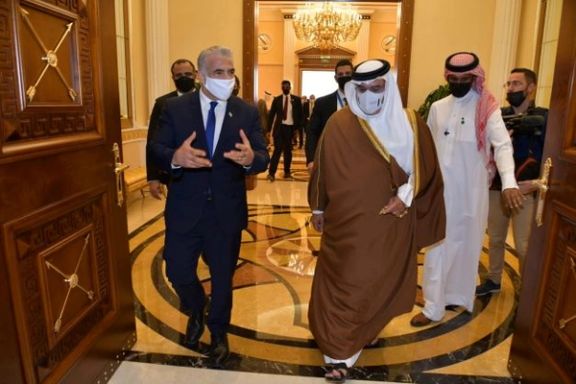
Israeli Foreign Minister during his visit to Bahrain. September 30, 2021

Iran said on Friday that a visit by Israel's foreign minister to Bahrain this week "left a stain" on the Gulf Arab state's rulers that "will not be erased".

Bahrain and Gulf neighbor United Arab Emirates normalized ties with Israel last year in a US-brokered deal known as the Abraham Accords that built on common commercial interests and worries about Iran.

Israeli Foreign Minister Yair Lapid, in a historic visit to strengthen normalization, met Bahraini King Hamad bin Isa Al Khalifa and Crown Prince and Prime Minister Salman bin Hamad Al Khalifa on Thursday. To signal cause against Iran, Lapid toured Bahrain's headquarters of the US Navy's Fifth Fleet, which has faced off with Iranian vessels in recent years.

“We condemn any scheme that bolsters Israel’s destructive presence in the region,” Iranian Foreign Ministry spokesman Saeed Khatibzadeh said in a statement carried by the official IRNA news agency.

“It is unfortunate that Bahrain’s rulers ignore the Zionist regime’s daily crimes against the oppressed but resilient people of Palestine,” Khatibzadeh said, referring to Israel.

“This stain will not be erased from the reputation of Bahrain’s rulers. The people of the region will continue to oppose the process of normalization of ties with the Zionist regime.”

Bahrain, a Sunni Muslim-ruled kingdom, accuses Iran of stoking unrest in Bahrain, a charge that Shi'ite Muslim Tehran denies. The island state, which quashed an uprising led mostly by Shi'ite members of its population in 2011, saw some sporadic acts of protest after the Abraham Accords were signed.

Reporting by Reuters

Most Viewed

US blockade enters murky phase as tankers spoof signals and buyers hesitate
1
ANALYSIS

US blockade enters murky phase as tankers spoof signals and buyers hesitate

2
INSIGHT

Ideology may be fading in Iran, but not in Kashmir's ‘Mini Iran'

3
INSIGHT

Hardliners push Hormuz ‘red line’ as US blockade tests Iran’s leverage

4
VOICES FROM IRAN

Hope and anger in Iran as fragile ceasefire persists

5

US sanctions oil network tied to Iranian tycoon Shamkhani

Banner
Banner

Spotlight

  • Hardliners push Hormuz ‘red line’ as US blockade tests Iran’s leverage
    INSIGHT

    Hardliners push Hormuz ‘red line’ as US blockade tests Iran’s leverage

  • Ideology may be fading in Iran, but not in Kashmir's ‘Mini Iran'
    INSIGHT

    Ideology may be fading in Iran, but not in Kashmir's ‘Mini Iran'

  • War damage amounts to $3,000 per Iranian, with blockade set to add to losses
    INSIGHT

    War damage amounts to $3,000 per Iranian, with blockade set to add to losses

  • Why the $100 billion Hormuz toll revenue is a myth
    ANALYSIS

    Why the $100 billion Hormuz toll revenue is a myth

  • US blockade targets Iran oil boom amid regional disruption
    ANALYSIS

    US blockade targets Iran oil boom amid regional disruption

  • Iran's digital economy battered by prolonged blackout
    INSIGHT

    Iran's digital economy battered by prolonged blackout

•
•
•

More Stories

Blinken Repeats Warning, 'Time Is Running Out On Talks With Iran'

Oct 1, 2021, 09:28 GMT+1

US Secretary of State Antony Blinken reiterated on Thursday that “the ball remains” in Iran’s court regarding an agreement to revive the 2015 nuclear deal, JCPOA.

Speaking to reporters in Pittsburgh, Pennsylvania, Blinken repeated that time is running out for resuming productive negotiations, as Iran builds up its stockpile of enriched uranium.

“Because of the work that Iran is doing on its nuclear program in violation of the JCPOA – spinning more sophisticated centrifuges, building up stockpiles of uranium enriched to 20 percent or even 60 percent – simply getting back to the terms of the JCPOA at some point will not be sufficient to recapture the benefits of the agreement because of the progress Iran has made,” Blinken said.

Iran began violating enrichment levels in 2019, set by the JCPOA, as retaliation against sanctions imposed by the former US administration that withdrew from the agreement in 2018.

President Joe Biden announced his intention to return to the nuclear agreement during last year’s presidential campaign, which would entail lifting tough sanction the Trump administration had imposed.

In April, talks began in Vienna between Iran and world powers who have remained in the agreement. The US participated in the talks indirectly, as Tehran refused to negotiate directly with Washington. But the talks were suspended in June after a new president was chosen in Iran. So far, more than a month after the formation of a government, Iran has still not returned to the talks, saying that it is studying the issue.

In response to a question about reports that Washington has appealed to Beijing to reduce its oil purchases from Iran to pressure it to return to the talks, Blinken spoke generally of the role other world powers need to play in to “prevail upon Iran to quickly return and see if we can still get back to the JCPOA.”

“So, there is a limited runway on that and the runway is getting shorter,” Blinken said.

Iran Bars 13 Followers Of The Baha'i Faith From Higher Education

Oct 1, 2021, 08:23 GMT+1
•
Maryam Sinaiee

The bar on Baha’i entering Iranian universities has blocked at least 13 hoping to enter higher education following success in national entrance examinations.

Human Rights News Agency (HRANA) reported Wednesday that Tehran resident Negar Sobhani-Azabadi was the 13th Baha’i to be denied third-level entrance this year due to her faith. According to HRANA, Sobhani-Azabadi discovered her rejection on grounds of “general ineligibility” on her school’s website when viewing her exam results.

Since the 1979 Revolution, Baha'is who openly state their faith cannot enter higher education, leading many to profess being Muslims. Any who later identify as Baha'is are expelled, even when on the verge of graduation.

Iranian Baha'is have since 1987 run an underground university, the Baháʼí Institute for Higher Education (BIHE), which despite prosecution of several teachers and students, has gained recognition from over 100 universities across the world who accept its graduates directly into their postgraduate schools.

The 1979 constitution of the Islamic Republic recognizes only Islam, Christianity, Judaism and Zoroastrianism. Baha'ism − established as a new religion in Iran in 1863 by Baha'ullah, who claimed to be a prophet following Jesus and Mohammad − has always been deemed heretical by the Shia establishment and subject to intermittent bouts of political persecution.

Supreme Leader Ali Khamenei has on several occasions called the Baha'i faith a cult and in a religious fatwa in 2018 forbade contact, including business dealings, with Baha'is.

HRANA reported in its 2020 annual report, released December 29, that in 2020 at least 45 Bahai’s were arrested, mostly on charges of "harming national security."

Baha'is, who number around 300,000 in Iran, say their rights are systematically violated, that they are often harassed, forced to leave their homes and businesses, and are deprived of government jobs.

Baha'is are also not allowed to bury their dead in public cemeteries. The cemeteries that they finance privately, usually in remote areas, are often desecrated. "Baha'is have no right to bury their dead, their dead should be collected [like rubbish] by the municipality," one cleric said in a program on state television (IRIB) in 2017.

There are Baha’i communities in many countries worldwide but there is no reliable figure about the total number of followers.

US Treasury Department Issues Guidance For Iran's Imam Reza Shrine

Sep 30, 2021, 22:38 GMT+1
•
Jason M. Brodsky

The US Treasury Department published guidance on Thursday concerning the impact of US sanctions on US persons visiting or making donations to the Imam Reza Holy Shrine in Mashhad, Iran.

During the Trump administration, the US government sanctioned Astan Quds Razavi, which manages the Imam Reza Holy Shrine and is a powerful religious foundation. Iran’s President Ebrahim Raisi is a former head of Astan Quds Razavi himself, and it controls vast holdings across Iran’s economy. Astan Quds Razavi was sanctioned under Executive Order 13876 for being owned or controlled, directly or indirectly, by Iran’s Supreme Leader. In the same designation, Raisi’s successor as custodian, Ahmad Marvi, was also sanctioned.

Thursday’s Frequently Asked Questions (FAQ) guidance cited US State Department’s travel advisory to Iran, warning against any visits by US persons given the risk of kidnapping, arbitrary arrest, and detention. But the FAQ clarified that for those who travel, transactions exempt from US sanctions include religious pilgrimages and the purchasing of goods and services for personal use.

The FAQ goes on to note that “donations of articles, such as food, clothing, and medicine, by US persons to the Imam Reza Holy Shrine intended to be used to alleviate human suffering also fall within an exemption and therefore generally are not prohibited under the Iran Transactions and Sanctions Regulations.” However, the FAQ warns certain transactions outside the scope of these regulations concerning Astan Quds Razavi may be prohibited by the sanctions.

The FAQ’s reference to the sanctions levied against Astan Quds Razavi and Executive Order 13876 is noteworthy as the US Treasury Department is essentially highlighting the fact that these sanctions remain on the books, despite demands by Iran’s government during the Vienna nuclear negotiations for Washington to lift all the sanctions imposed by former President Donald Trump, including Executive Order 13876 targeting the Office of Iran’s Supreme Leader. At the same time, the Biden administration is seeking to underscore that there are humanitarian exemptions embedded in the US sanctions architecture.

Amid Fears Of Power Shortage, Iran Allows Cryptocurrency Mining To Resume

Sep 30, 2021, 17:30 GMT+1

Iran has permitted licensed cryptocurrency mining machines to resume operations after a three-month lull ordered by former President Hassan Rouhani.

Around seven percent of world cryptocurrency mining by powerful computers that use a lot of electricity is estimated to be taking place in Iran. The world’s cheapest electricity rates in the country encourage to lucrative business, in some cases with the involvement of some Chinese entities.

Iran experienced renewed electricity shortages in June when temperatures rose and air-conditioning units were turned on. The controversial practice of cryptocurrency mining was banned for three months, although tens of thousands of illegal, underground computers continued to work.

Electricity shortages are again expected in the winter, as Iran is chronically short of power generation due mainly to lack of investments in the sector. A severe drought in 2021 has further reduced power generation as most dams are more than half empty.

Although some officials have said that crypto mining only uses 300 megawatts of power, others have warned that usage is much higher and it can threaten to power grid.

Local media have been reporting that even in some government offices illegal crypto machines have been operating. The director of Tehran’s stock exchange Wednesday announced his resignation after cryptocurrency mining machines were uncovered at the offices of the organization.

Israeli FM Thanks Bahrain King For 'Warm, Hopeful' Meeting

Sep 30, 2021, 17:04 GMT+1

Israel's foreign minister thanked Bahrain's King Hamad bin Isa Al Khalifa for a "warm and hopeful meeting" on Thursday as part of a landmark trip to the small Gulf state.

Yair Lapid's arrival was the first high-level visit to the country by a senior Israeli official since the signing last year of an agreement to establish diplomatic ties.

"The king's leadership and inspiration led to genuine cooperation and the meeting paved the way for the continuation of the relationship," Lapid said a statement released by the Israeli Foreign Ministry.

Lapid had earlier landed in Bahrain's capital, Manama, for meetings with his Bahraini counterpart and to inaugurate Israel's embassy.

Israel established formal diplomatic relations with four Arab states last year as part of the U.S.-brokered "Abraham Accords."

Lapid has already visited the United Arab Emirates and Morocco and opened Israel's diplomatic offices there since he became Israel's foreign minister in June.

Bahrain's first ambassador to Israel arrived earlier this month and presented his credentials to Israel's figurehead president on the anniversary of the signing of the accords.

The two countries had long enjoyed clandestine security ties over a shared distrust of regional rival Iran, but only last year took the relationship public.

Report by AP